

Initial Experience of Vantage Galan 3T / Supreme Edition
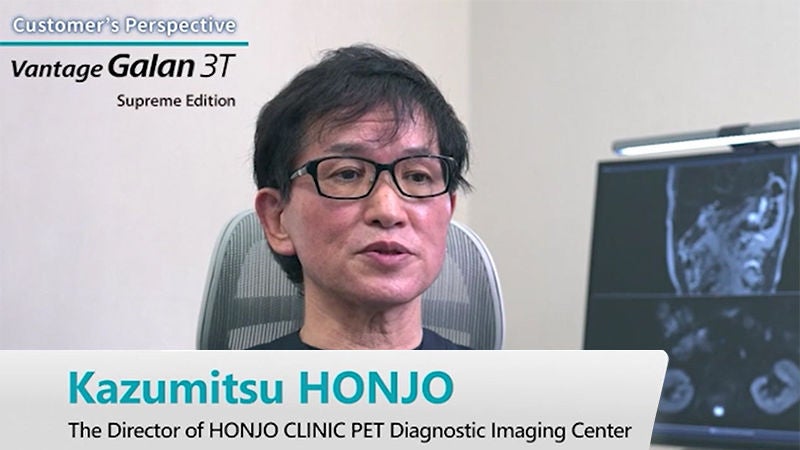
Kazumitsu Honjo, MD, PhD
Why Vantage Galan 3T / Supreme Edition
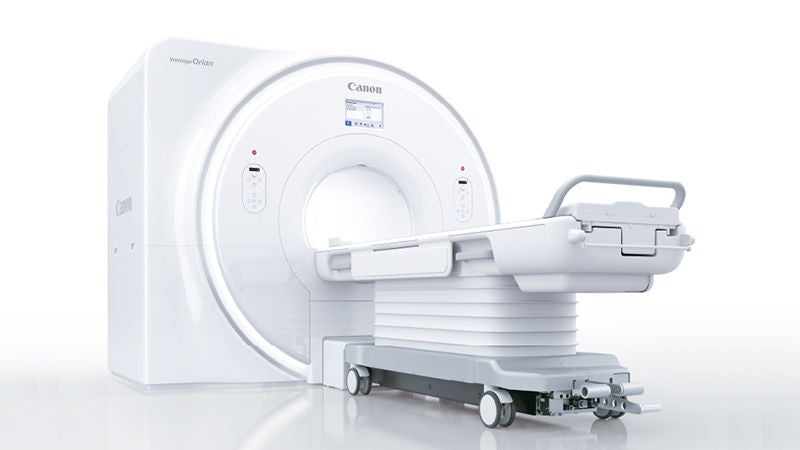
I have been involved in MRI diagnosis for 37 years and have been looking forward to the further development of MRI, which combines high spatial resolution, high contrast resolution and functional imaging. In the past, I have used foreign-made MRI systems, but I was very interested in the new 3T MRI system developed in-house by Canon Medical Systems Corporation which incorporates the latest hardware and software technologies, including a newly developed magnet. Better imaging diagnosis for patients is provided by high magnetic field homogeneity, all made-in-Japan hardware such as the new gradient coil and the new high-speed calculation system, and AI based reconstruction technologies like Advanced intelligent Clear-IQ Engine (AiCE) and Precise IQ Engine (PIQE), which are expected to provide the ultimate in clinical MRI diagnosis at present. As a result, I decided to install this 3T MRI system packed full of Canon’s advanced technology.

“We can feel the pride of Canon in this new system.”
Kazumitsu Honjo, MD, PhD
Director
Honjo Clinic PET Diagnostic Imaging Center, Japan
New in-house made-in-Japan magnet
The magnet is at the core of MRI system, and image quality and resolution depend on the magnetic field homogeneity.
Also, distortion occurring at the edges of the image due to the magnetic field inhomogeneity can become a problem when imaging a wide area of the torso.
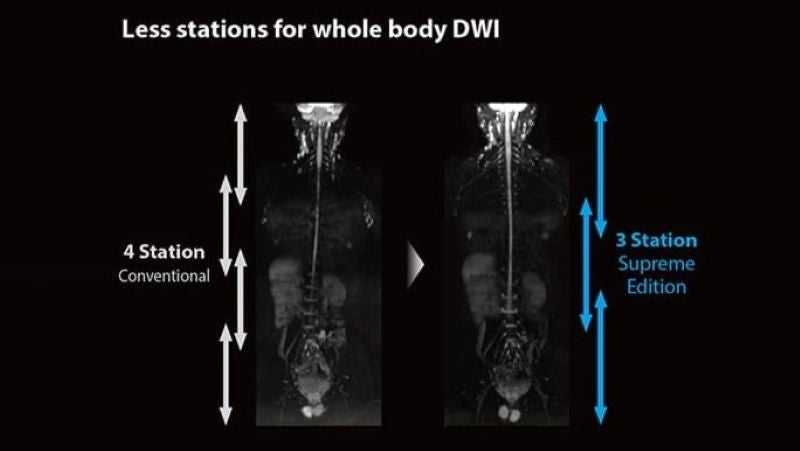
When we reviewed images scanned with Vantage Galan 3T / Supreme Edition, we were surprised at how little distortion there was. For example, even when imaging the spine with a 50 cm field of view (FOV), very clear images could be obtained with almost no distortion.
When I visited the magnet factory in Ako, Hyogo Prefecture, Japan, I was impressed by the craftsmanship of the manufacturing staff, who used a high level of skill and care in every step of the manufacturing process to produce magnets with high magnetic field homogeneity.
Initial experience with PIQE
PIQE is the deep learning-based reconstruction technology not only for noise reduction but also for increasing resolution. Utilizing PIQE, high-resolution images can be obtained in many clinical regions that is beyond current expectations.
Now, PIQE is applicable with almost all 2D pulse sequences and generates higher spatial resolution images with the ability to triple the matrix in both in-plane directions, making it very useful. Images with micron-level resolution have been acquired not only in the central nervous system and spinal cord regions, but also in breath-hold imaging of the upper abdominal region.
For example, in pancreatic examinations, pancreatic duct can be depicted very clearly even in T1-weighted images, and small pancreatic cysts of 1 to 2 mm can be detected that were previously difficult to capture.
Also, gallbladder images with a spatial resolution of about 100 micrometers has been achieved. Specifically, the ability to detect the surface structure of the gallbladder and small cholesterol polyps has improved.
The other benefit of PIQE is scan time reduction. For example, if the number of phase encoding of conventional image matrix (for example 256 × 256) is reduced by half (256 × 128), the scan time can be reduced by half. By applying PIQE to the image with a reduced number of phase encoding, image resolution becomes the equivalent to or greater than that of conventional images while reducing scan time. This is extremely useful for abdominal region examinations for those who have difficulty holding their breath. When PIQE was applied to FASE 2D, one of the sequences for fast scanning, it allowed further reduction of scan time and burden on patient. In addition, PIQE has a lot of use cases. For example, phase encoding matrix is reduced to save scan time, which can be used to increase the number of images. PIQE enables the ability to set scan conditions depending on the situation.
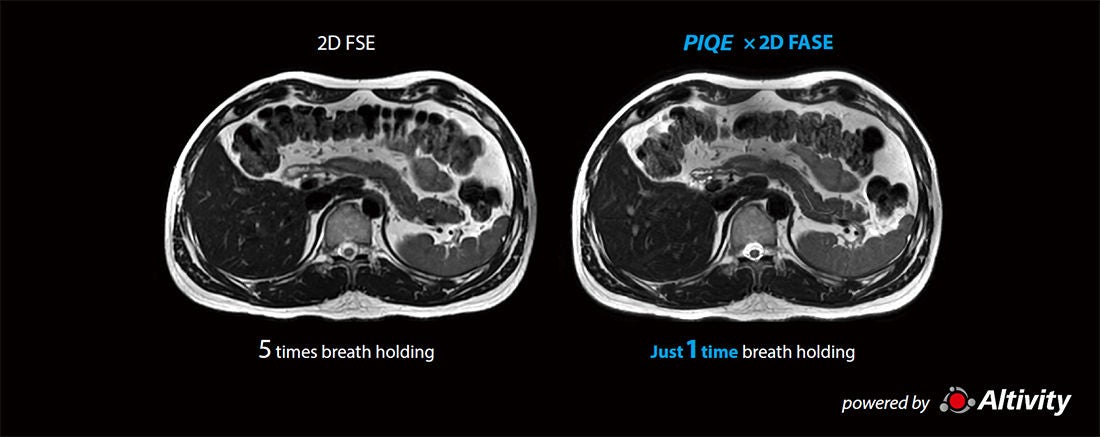
- Figure 1
Initial experience of Zoom DWI
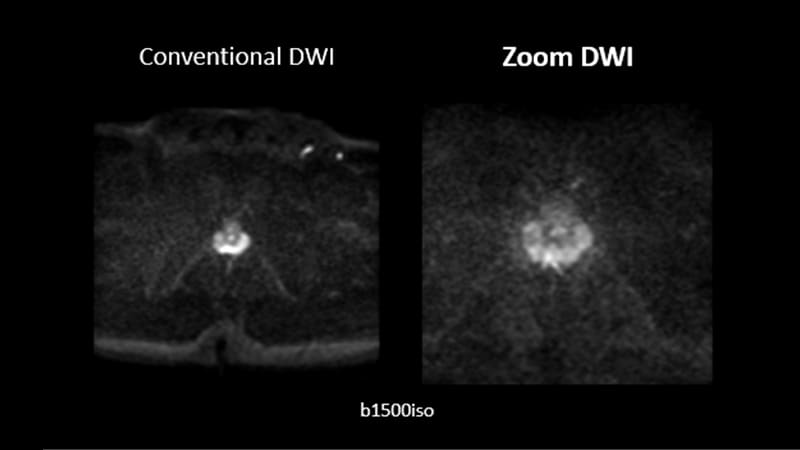
Zoom DWI is a function that rotates the excitation pulse by a specific angle relative to the refocusing pulse to obtain images without aliasing artifacts in the phase encoding direction. At our hospital, Zoom DWI is used mostly in the pancreas and the prostate, resulting in the acquisition of diffusion images with higher resolution compared with conventional images.
Also, typically when scanning DWI of the trunk using a 3T system, the signal is often not homogeneous, but when using Zoom DWI on the Vantage Galan 3T / Supreme Edition, the signal becomes homogeneous. Utilizing this technology, pancreatic head cancer of approximately 1 cm has been found. When comparing Zoom DWI with a conventional scan, lesions that could not be captured under conventional conditions were depicted as high signals, which truly amazed us.
In prostate examination, it is now possible to acquire images that show anatomical structures such as the surgical capsule and the boundary between the inner and outer linings, which were not visible with conventional diffusion techniques. Zoom DWI can be used with PIQE and can measure apparent diffusion coefficient (ADC) accurately, making it a very useful application.
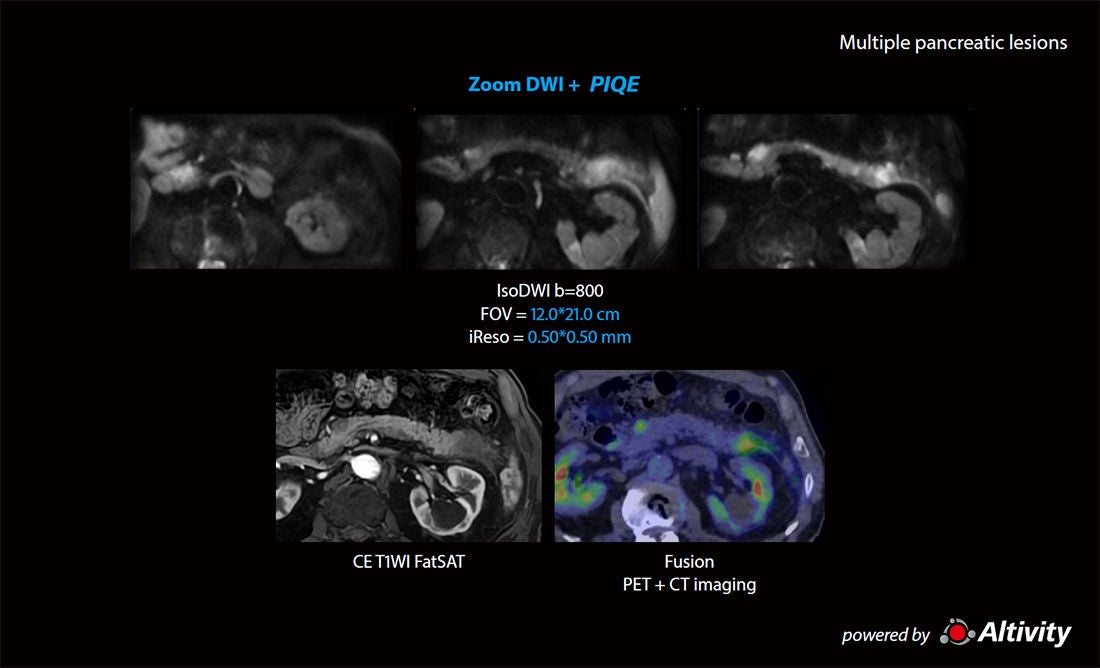
- Figure 2
- Disclaimer
The clinical results, performance and views described in this document are the experience of the health care providers. Results may vary due to clinical setting, patient presentation and other factors. Many factors could cause the actual results and performance of Canon’s product to be materially different from any of the aforementioned.
Some features presented in this article may not be commercially available on all systems shown or may require the purchase of additional options.
Due to local regulatory processes, some commercial features included in this publication may not be available in some countries. Please contact your local representative from Canon Medical Systems for details and the most current information.
The AI technology was trained during the development phase. When implemented into the product, the AI function no longer self-learns.
Kazumitsu Honjo, MD, PhD
Director
Honjo Clinic PET Diagnostic Imaging Center, Japan
For more information


The content reflects information available at the time of publication and may differ from current information.
Social Media


