Search

Customer Experience

Dr. Patrik Rogalla
Joint Dept. of Medical Imaging,
University of Toronto, Canada

“PIQE has revolutionized the image quality, in particular in chest imaging.”

Image

Dr. Patrik Rogalla
Joint Dept. of Medical Imaging, University of Toronto, Canada

“I have great expectations that lung imaging in general will significantly improve with the use of Deep Learning.”

Image

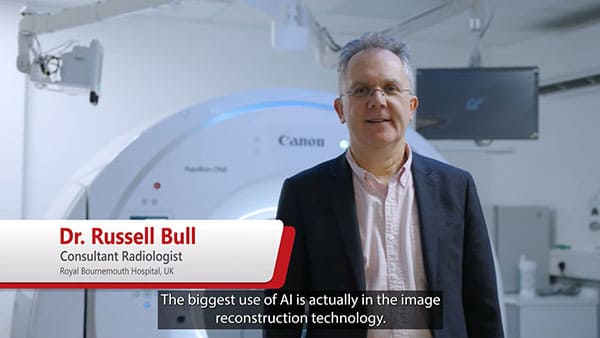
Dr. Russell Bull,
Royal Bournemouth Hospital, UK

“Everything’s the same as it was before, but the resolution’s many, many times better.”

Image

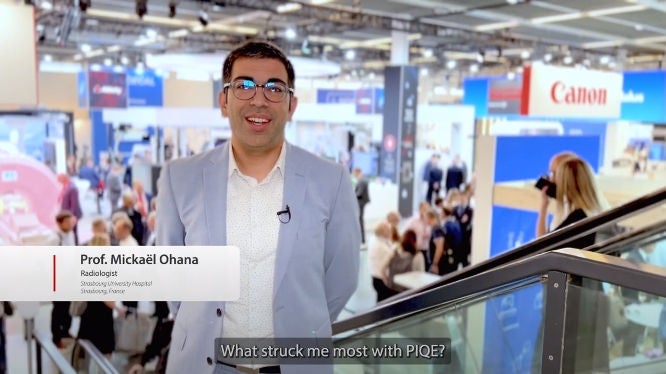
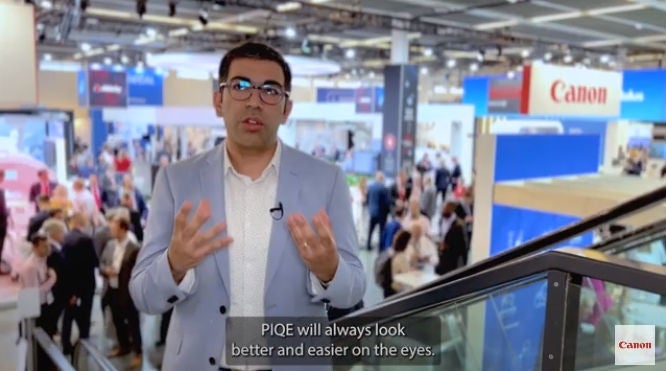
Mickaël Ohana, MD, PhD
Strasbourg University, France

“Increased spatial resolution with less image noise—[PIQE] combining both is really a tremendous step forward.”

image

Mickaël Ohana, MD, PhD
Strasbourg University, France

“I would definitely choose PIQE over the other reconstructions for all of the coronary CTA that we analyzed.”

Image

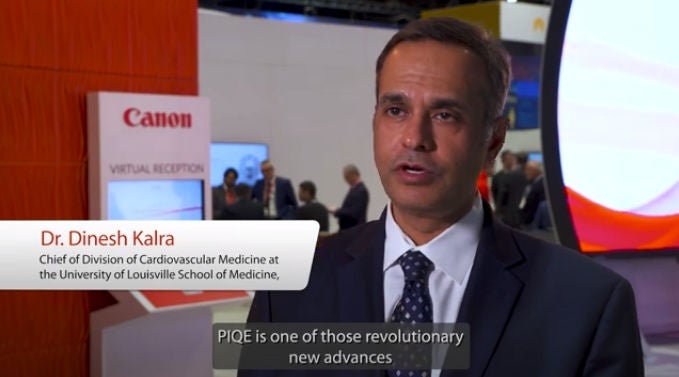
Dinesh Kalra, MD, FACC, FNLA, FSCCT, FSCMR
University of Louisville, USA

“[PIQE] gives me a lot of confidence in looking at small vessels and making an accurate diagnosis.”

Image

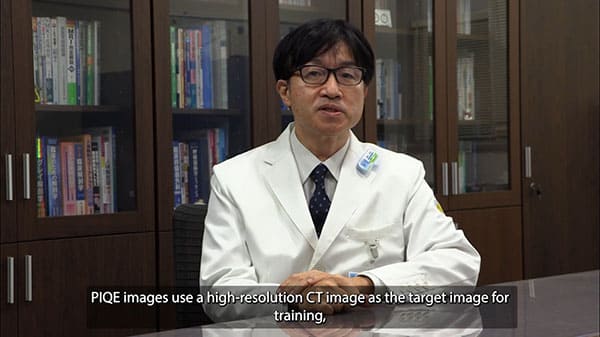
Dr. Kazuo Awai
Hiroshima University, Japan

“PIQE images have a very natural texture and the noise appears to be greatly reduced.”

Image

Dr. Russell Bull
Royal Bournemouth Hospital, UK

“PIQE has massively improved our image quality and our diagnostic confidence.”

Image

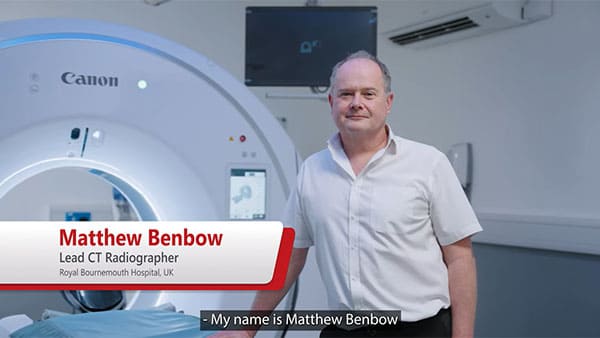
Matthew Benbow
Royal Bournemouth, UK

“For the same dose or for lower doses, the quality of image that we’re getting now is outstanding.”

Image

Clinical Education

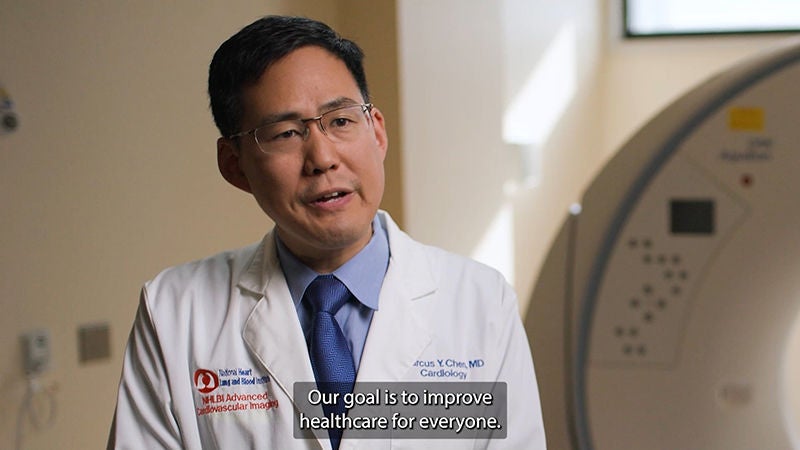
Dr. Marcus Chen
National Institutes of Health, USA

"What I am most impressed with PIQE is that it’s as if you are wearing glasses for the first time. I can now see very fine detail."

Image

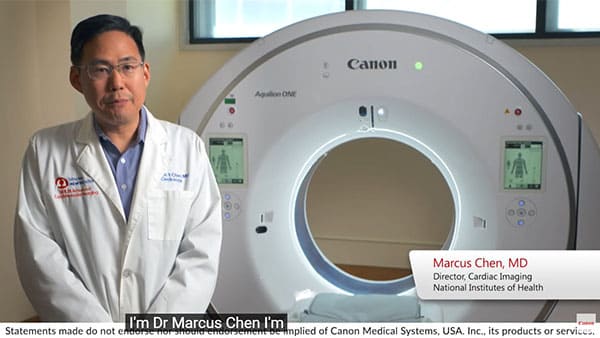
Dr. Marcus Chen
National Institutes of Health, USA

“With PIQE 1024, we are more confidently able to exclude instent restenosis when compared to a traditional 512 image matrix.”

Image

White paper

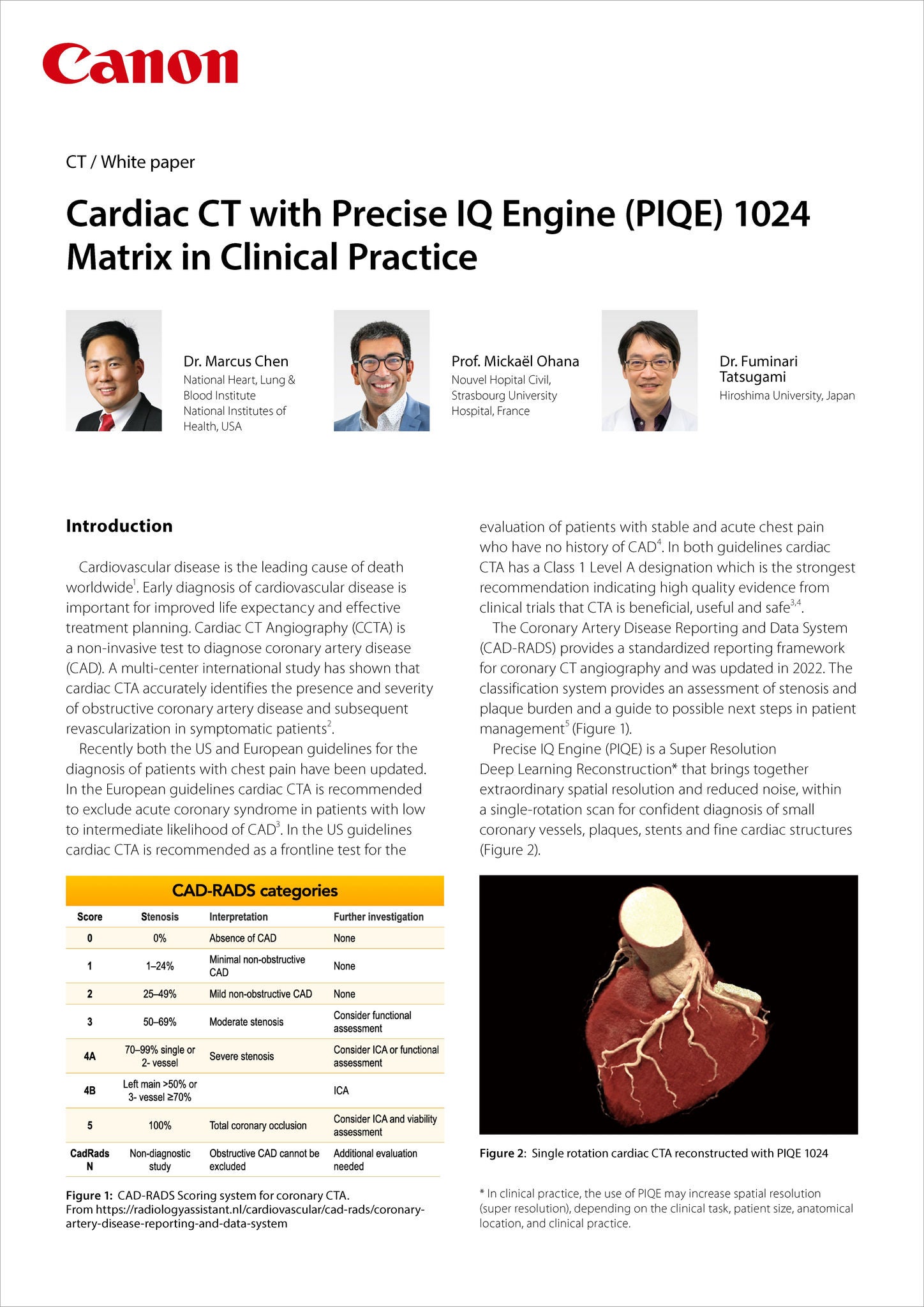
Cardiac CT with Precise IQ Engine (PIQE) 1024 Matrix in Clinical Practice

White paper

Precision-Trained Deep Learning: Redefining Cardiac Imaging


“With AiCE and PIQE you can have your cake and eat it too –great image quality at significantly lower radiation doses.”


Dr. Timothy Shore

Staff Specialist Diagnostic and Interventional Radiologist
North Shore Radiology and Nuclear Medicine (NSRNM), Sydney, Australia

image

Case study

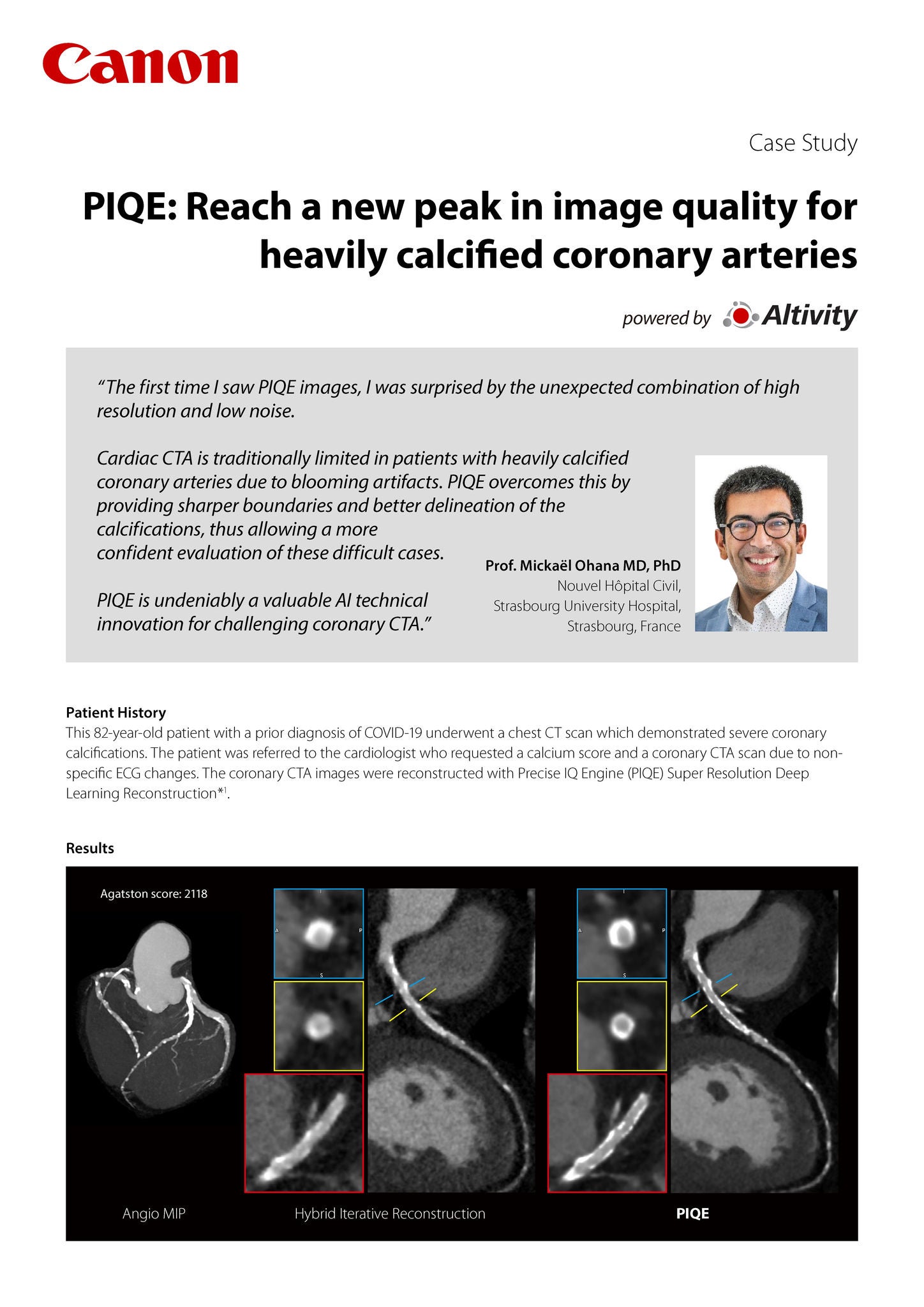
PIQE: Reach a new peak in image quality for heavily calcified coronary arteries

Case study

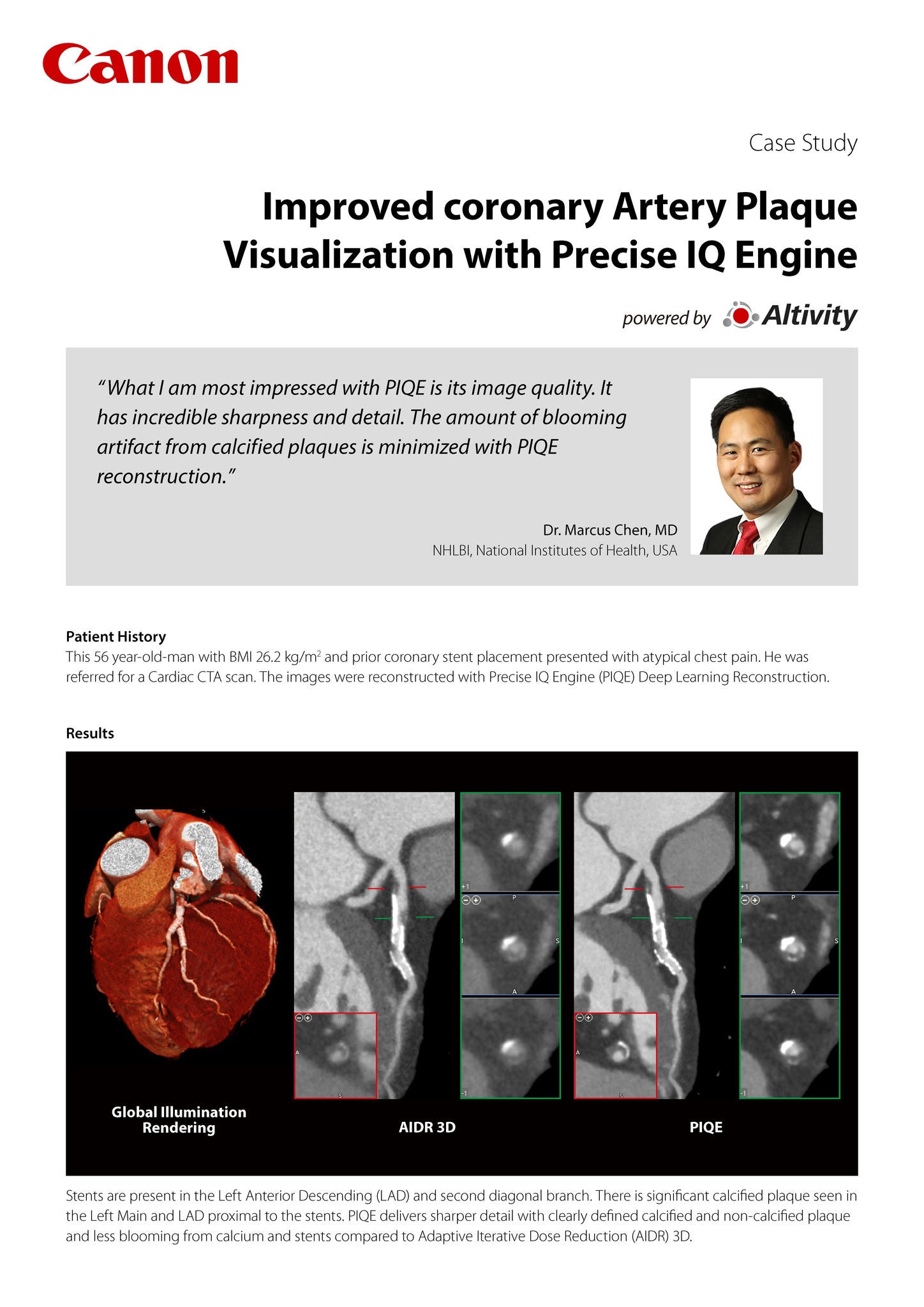
Improved coronary Artery Plaque Visualization with Precise IQ Engine


PIQE Scientific Evidence

Improvement of Spatial Resolution on Coronary CT Angiography by Using Super-Resolution Deep Learning Reconstruction

Fuminari Tatsugami, Toru Higaki, Ikuo Kawashita, Wataru Fukumoto, Yuko Nakamura, Masakazu Matsuura, Tzu-Cheng Lee, Jian Zhou, Liang Cai, Toshiro Kitagawa, Yukiko Nakano, Kazuo Awai,


Acad Radiol. 2023 Jan 19;S1076-6332(22)00700-0. doi: 10.1016/j.acra.2022.12.044.


Conclusion: SR-DLR was superior to hybrid IR with respect to the image noise, the sharpness of coronary artery margins, and plaque detectability.

Impact of a Deep Learning-based Super-resolution Image Reconstruction Technique on High-contrast Computed Tomography: A Phantom Study
Hideyuki Sato, Shinichiro Fujimoto, Nobuo Tomizawa, Hidekazu Inage, Takuya Yokota, Hikaru Kudo, Ruiheng Fan, Keiichi Kawamoto, Yuri Honda, Takayuki Kobayashi, Tohru Minamino, Yosuke Kogure,

Acad Radiol. 2023 Jan 21;S1076-6332(22)00696-1. doi: 10.1016/j.acra.2022.12.040.

Conclusion: The present results suggest that DLSRR can achieve greater noise reduction and improved spatial resolution in the high-contrast region compared with conventional DLR and iterative reconstruction techniques.

Super-resolution deep learning reconstruction at coronary computed tomography angiography to evaluate the coronary arteries and in-stent lumen: An initial experience
Makoto Orii, Misato Sone, Takeshi Osaki, Yuta Ueyama, Takuya Chiba, Tadashi Sasaki, Kunihiro Yoshioka

Research Square. DOI: https://doi.org/10.21203/rs.3.rs-1875541/v2

Conclusion: SR-DLR improves the image quality of the coronary arteries and in-stent lumen at CCTA. Datasets
reconstructed with SR-DLR empower the clinician with the high-contrast signal definition and reduce
noise, relative to conventional MBIR.

Coronary Stent Evaluation by CTA: Image Quality Comparison Between Super-Resolution Deep-Learning Reconstruction and Other Reconstruction Algorithms

Yasunori Nagayama, Takafumi Emoto, Hidetaka Hayashi, Masafumi Kidoh, Seitaro Oda, Takeshi Nakaura, Daisuke Sakabe, Yoshinori Funama, Noriaki Tabata, Masanobu Ishii, Kenshi Yamanaga, Koichiro Fujisue, Seiji Takashio, Eiichiro Yamamoto, Kenichi Tsujita, and Toshinori Hirai,

AJR, 2023, https://doi.org/10.2214/AJR.23.29506


Conclusion: SR-DLR yielded improved delineation of the stent strut and in-stent lumen, with better image sharpness and less image noise and blooming artifacts, in comparison with HIR, MBIR, and NR-DLR.

Improving image quality with super-resolution deep-learning-based reconstruction in coronary CT angiography

Yasunori Nagayama, Takafumi Emoto, Yuki Kato, Masafumi Kidoh, Seitaro Oda, Daisuke Sakabe, Yoshinori Funama, Takeshi Nakaura, Hidetaka Hayashi, Sentaro Takada, Ryutaro Uchimura, Masahiro Hatemura, Kenichi Tsujita & Toshinori Hirai,


European Radiology 2023, https://doi.org/10.1007/s00330-023-09888-3


Conclusion: SR-DLR considerably improved the subjective and objective image qualities and object detectability of CCTA relative to HIR, MBIR, and NR-DLR algorithms.

Coronary computed tomography angiographic detection of in-stent restenosis via deep learning reconstruction: a feasibility study
Hideki Kawai, Sadako Motoyama, Masayoshi Sarai, Yoshihiro Sato, Takahiro Matsuyama, Ryota Matsumoto, Hiroshi Takahashi, Akio Katagata, Yumi Kataoka, Yoshihiro Ida, Takashi Muramatsu, Yoshiharu Ohno, Yukio Ozaki, Hiroshi Toyama, Jagat Narula, Hideo Izawa,

European Radiology 2023 Sep 6, https://doi.org/10.1007/s00330-023-10110-7

Conclusion: PIQE provides superior image quality and diagnostic accuracy for ISR, even with stents measuring < 3.0 mm in diameter.

Clinical relevance statement: With improvements in the diagnostic accuracy of in-stent stenosis, CT angiography could become a gatekeeper for ICA in post-stenting cases, obviating ICA in many patients after recent stenting with infrequent ISR and allowing non-invasive ISR detection in the late phase

Super-Resolution Deep Learning Reconstruction for Improved Image Quality of Coronary CT Angiography

Takafuji M, Kitagawa K, Mizutani S, Hamaguchi A, Kisou R, Iio K, Ichikawa K, Izumi D, Sakuma H. Super-Resolution Deep Learning Reconstruction for Improved Image Quality of Coronary CT Angiography.

Radiol Cardiothorac Imaging. 2023 Aug 17;5(4):e230085. doi: 10.1148/ryct.230085. PMID: 37693207; PMCID: PMC10485715.

Conclusion: SR-DLR improved vessel sharpness, image noise, and accuracy of coronary stenosis grading compared with the C-DLR technique.

Super-resolution deep learning reconstruction to improve image quality of coronary CT angiography

Nobuo Tomizawa, Yui Nozaki, Hideyuki Sato, Yuko Kawaguchi, Ayako Kudo, Daigo Takahashi, Kazuhisa Takamura, Makoto Hiki, Shinichiro Fujimoto, Iwao Okai, Seiji Koga, Shinya Okazaki, Kanako K Kumamaru, Tohru Minamino, Shigeki Aoki, Super-resolution deep learning reconstruction to improve image quality of coronary CT angiography,
Radiology Advances, 2024;, umae001, https://doi.org/10.1093/radadv/umae001

Conclusion: Our exploratory analysis suggests that super-resolution deep learning reconstruction could improve image quality with lower tube current settings than model-based iterative reconstruction with similar diagnostic performance to diagnose coronary stenosis in coronary CT angiography.

Comparison of two deep-learning image reconstruction algorithms on cardiac CT images: A phantom study

Greffier J, Pastor M, Si-Mohamed S, Goutain-Majorel C, Peudon-Balas A, Bensalah MZ, Frandon J, Beregi JP, Dabli D. Comparison of two deep-learning image reconstruction algorithms on cardiac CT images: A phantom study.

Diagn Interv Imaging. 2024 Mar;105(3):110-117. doi: 10.1016/j.diii.2023.10.004. Epub 2023 Nov 8. PMID: 37949769.

Conclusion: Compared to AiCE, PIQE reduced noise, improved spatial resolution, noise texture and detectability of simulated cardiac lesions. PIQE seems to have a greater potential for dose reduction in cardiac CT acquisition.

Evaluation of four computed tomography reconstruction algorithms using a coronary artery phantom
Sawamura S, Kato S, Funama Y, Oda S, Mochizuki H, Inagaki S, Takeuchi Y, Morioka T, Izumi T, Ota Y, Kawagoe H, Cheng S, Nakayama N, Fukui K, Tsutsumi T, Iwasawa T, Utsunomiya D. Evaluation of four computed tomography reconstruction algorithms using a coronary artery phantom.

Quant Imaging Med Surg. 2024 Apr 3;14(4):2870-2883. doi: 10.21037/qims-23-1204. Epub 2024 Mar 27. PMID: 38617144; PMCID: PMC11007503.

Conclusions: 2nd generation DLR provided better CNR and ERS in coronary CTA than HIR, MBIR, and previous-generation DLR, leading to the highest subjective image quality in the assessment of vessel stenosis.

Improved stent sharpness evaluation with Super-Resolution deep learning reconstruction in coronary computed tomography angiography
Ryu JK, Kim KH, Otgonbaatar C, Kim DS, Shim H, Seo JW. Improved stent sharpness evaluation with Super-Resolution deep learning reconstruction in coronary computed tomography angiography.

Br J Radiol. 2024 May 11:tqae094. doi: 10.1093/bjr/tqae094. Epub ahead of print. PMID: 38733576.

Conclusions: SR-DLR produces images with lower image noise, leading to improved overall image quality, compared with HIR and DLR. SR-DLR is a valuable image reconstruction algorithm for enhancing the spatial resolution and sharpness of coronary artery stents without being constrained by hardware limitations.

Advanced in knowledge: The overall image quality was significantly higher in SR-DLR, resulting in sharper coronary artery stents compared to HIR and DLR.