


Search

⁠Scientific publication highlights

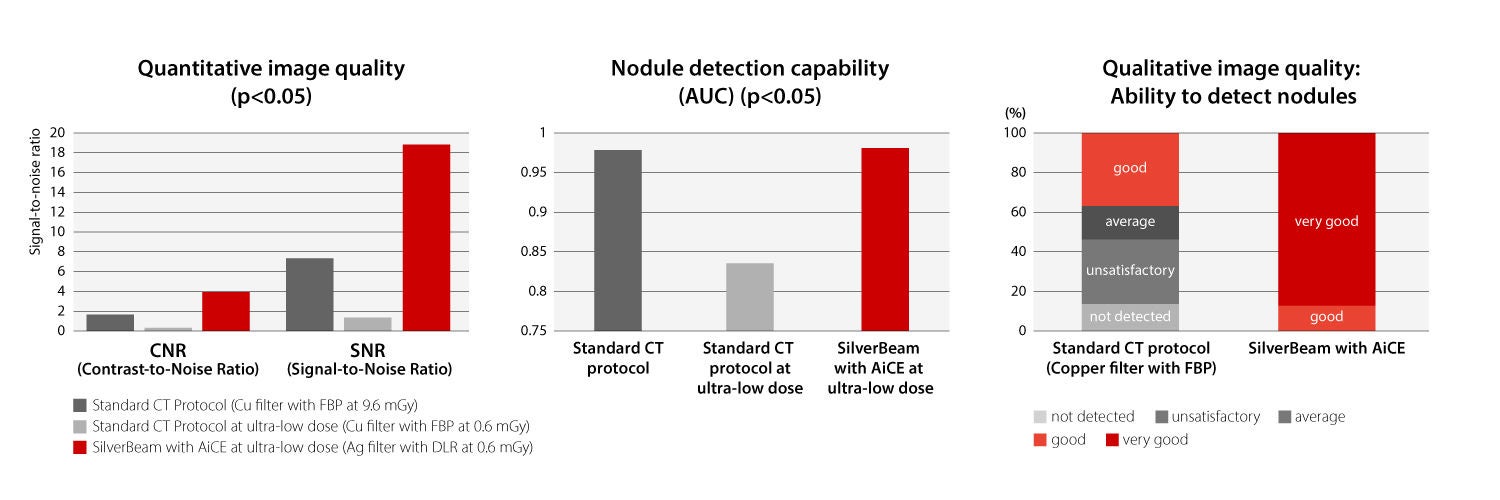
Achieving 94% Dose Reduction with improved image quality and no loss of nodule detection capability using SilverBeam and AiCE

High quality images at a low radiation dose are required to optimize the early detection of lung cancer while minimizing the downstream risks of repeated radiation exposure to yield the benefits of lung cancer screening. This study explores the use of a silver-based spectral filter (SilverBeam) and an AI reconstruction algorithm (AiCE) to achieve significant dose reduction while preserving image quality and lung nodule detection accuracy across varying dose levels.
Image

Conclusion:

"The Silver filter and DLR (Deep Learning Reconstruction) can significantly improve image quality and nodule detection capability compared with the Copper filter and other reconstruction methods at each of radiation doses used."

Oshima, Yuka et al. | Capability for dose reduction while maintaining nodule detection: Comparison of silver and copper X-ray spectrum modulation filters for chest CT using a phantom study with different reconstruction methods | European journal of radiology vol. 166 (2023)

White papers and case studies

Download our latest white papers and case studies on lung cancer screening solutions using Canon technologies here.
The power of SilverBeam with DLR for high quality lung cancer screening exams

Christiana Balta, PhD
Science & Product Manager
Canon Medical Systems Europe
Image

SilverBeam: Creating New Possibilities in CT Lung Screening

Dr. Marcus Chen
Director of Cardiothoracic Imaging at the National Institutes for Health (NIH), Maryland, US.
Download PDF
Image

CT Lung Screening at the Radiation Dose of a Chest X-ray

Dr. Russell Bull

Royal Bournemouth Hospital,
Bournemouth, UK
Download PDF
CT Lung Screening

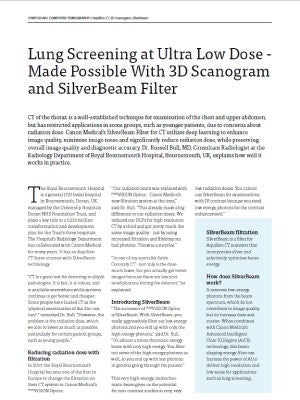
Lung Screening at Ultra Low Dose - Made Possible With 3D Scanogram and SilverBeam Filter

Dr. Russell Bull
Royal Bournemouth Hospital,
Bournemouth, UK
Image

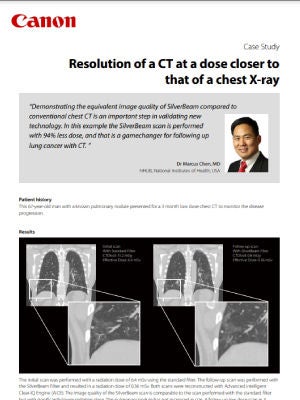
Resolution of a CT at a dose closer to that of a chest X-ray

Dr. Marcus Chen, MD.
NHLBI, National Institutes of Health,
USA

Image

⁠Scientific papers

Find our latest scientific evidence on lung cancer screening solutions using Canon technologies here.

Hamada, A et al. | Comparison of deep-learning image reconstruction with hybrid iterative reconstruction for evaluating lung nodules with high-resolution computed tomography| Journal of Computer Assisted Tomography (2023)


Oshima, Y et al. | Capability for dose reduction while maintaining nodule detection: Comparison of silver and copper X- ray spectrum modulation filters for chest CT using a phantom study with different reconstruction methods|European Journal of Radiology (2023)


Goto, M et al. | Lung- optimized deep-learning-based reconstruction for ultralow-dose CT| Academic Radiology (2023)


Hamabuchi N et al. | Effectiveness of deep learning reconstruction on standard to ultra-low-dose high-definition chest CT images | Japanese Journal of Radiology (2023)


K. Boedeker et al. | Technical Evaluation of a Low Dose Lung Cancer Screening Computed Tomography Protocol using a Beam- Shaping Silver Filter and Deep Learning Reconstruction.


Watanabe, S et al.| Pulmonary nodule volumetric accuracy of a deep learning- based reconstruction algorithm in low- dose computed tomography: A phantom study | Physica Medica (2022)


Mikayama, R et al. | Deep-learning reconstruction for ultra- low- dose lung CT: volumetric measurement accuracy and reproducibility of artificial groundglass nodules in a phantom study|The British Journal of Radiology (2022)


Keiichi Nomura et al. | Radiation Dose Reduction for Computed Tomography Localizer Radiography Using an Ag Additional Filter | J Comput Assist Tomogr (2021)


Ortlieb, A. C et al. | Impact of Morphotype on Image Quality and Diagnostic Performance of Ultra-Low-Dose Chest CT | Journal of Clinical Medicine (2021)


Singh R et al. | Image Quality and Lesion Detection on Deep Learning Reconstruction and Iterative Reconstruction of Submillisievert Chest and Abdominal CT | American Journal of Roentgenology (2020)


Yanagawa, M et al. | Lung adenocarcinoma at CT with 0.25- mm section thickness and a 2048 matrix: high-spatial-resolution imaging for predicting invasiveness |Radiology (2020)


Tsubamoto, M et al. | Ultra high-resolution computed tomography with 1024-matrix: Comparison with 512-matrix for the evaluation of pulmonary nodules. |European Journal of Radiology (2020)


Lucia J M Kroft et al. | Added Value of Ultra-Low-Dose Computed Tomography, Dose Equivalent to Chest x-Ray Radiography, for Diagnosing Chest Pathology | J Thorac Imaging (2019)


Fujita, M et al. | Lung cancer screening with ultra-low dose CT using full iterative reconstruction | Japanese journal of radiology (2017)


Meyer, E. et al. | Wide-volume versus helical acquisition in unenhanced chest CT: prospective intra-patient comparison of diagnostic accuracy and radiation dose in an ultra- low-dose setting |European Radiology (2019)


Schaal, M. et al. | Diagnostic Performance of Ultra-Low-Dose Computed Tomography for Detecting Asbestos-Related Pleuropulmonary Diseases: Prospective Study in a Screening Setting| PLOS One (2016)


Kakinuma R et al. | Ultra-High-Resolution Computed Tomography of the Lung: Image Quality of a Prototype Scanner | PLoS ONE (2015)


Nomura, Y et al. | Effects of iterative reconstruction algorithms on computer-assisted detection (CAD) software for lung nodules in ultra- low- dose CT for lung cancer screening |Academic Radiology (2017)