

AI Scientific Evidence - CT
Deep Learning Reconstruction algorithms can reduce radiation dose and improve image quality in CT angiography
Cardiac experts from the University Hospital of Dijon have incorporated cardiac CT Angiography (CTA) for all patients with stroke symptoms as part of their initial stroke work-up, while adding important information. To better understand the patient’s underlying etiology, the additional acquisition results in increased radiation exposure. As such, strategies to reduce radiation dose without sacrificing image quality are needed.
The potential of radiation dose reduction in cardiac CTA was investigated by Bernard et al. The authors compared Canon’s CT Deep Learning-based Reconstruction (DLR) to Hybrid Iterative Reconstruction (HIR) in terms of radiation dose and image quality. 300 consecutive patients with suspected stroke underwent cardiac CTA reconstructed either with HIR or with DLR. For each CT reconstruction algorithm, image quality and radiation dose were evaluated.
The use of the DLR algorithm for cardiac CTA in an acute stroke imaging protocol showed an approximate 51% improvement in Signalto- Noise Ratio (SNR), 49% improvement in contrast-to-noise ratio(CNR) and 40% reduction in radiation dose compared to HIR. See Table 1.
HIR | DLR | P value | |
Dose-length product (DLP) [mGy∙cm] | 176.1±37.1 | 106.4±50.0 | <0.001 |
Volume CT dose index (CTDIvol) [mGy] | 11.5±2.2 | 6.9±3.2 | <0.001 |
Effective dose [mSv] | 2.5±0.5 | 1.5±0.7 | <0.001 |
- Table 1: Radiation dose comparison between Hybrid Iterative Reconstruction (AIDR 3D) and Deep Learning Reconstruction (AiCE).
Data are presented as mean ± standard deviation. Table adapted from reference (Bernard et al. 2021)
Reference
Bernard et al. | Deep learning reconstruction versus iterative reconstruction for cardiac CT angiography in a stroke imaging protocol: reduced radiation dose and improved image quality. | Quant Imaging Med Surg. (2021)
https://pubmed.ncbi.nlm.nih.gov/33392038/
How does Deep Learning Reconstruction affect image quality and radiation dose reduction in pediatric patients?
CT image quality improvement and lower patient radiation dose are important in all patients but even more essential in pediatric patients. The solution to this challenge may arise from recent technological advances such as Deep Learning Reconstruction (DLR). Recently, Brady et al. compared current clinical CT reconstruction algorithms to a DLR algorithm when pediatric patients were scanned based on the clinical indication for trauma. Image datasets were reconstructed using Model-Based Iterative Reconstruction (MBIR), Statistical-Based Iterative Reconstruction (SBIR), Filtered Back Projection (FPB), and DLR. The CT image quality of the different reconstruction algorithms was assessed subjectively by radiologists and objectively by mathematical observer models.
Compared to MBIR, SBIR, and FPB, the DLR algorithm demonstrated higher object detection ability and accuracy. The subjective image quality investigation showed that the radiologists preferred DLR images over SBIR and MBIR images because of the improved object edge definition and quantum noise texture. Therefore, DLR had higher image quality ratings with greater radiologist preference and higher confidence ratings.
The analysis of different image thicknesses showed that DLR images at 0.5 mm and 3 mm showed equal or better detection accuracy than 3 mm SBIR images. This gives end-users multiple options such as using 0.5 mm slices to reduce partial volume artifacts, while favorably reducing quantum noise.
DLR has a greater radiation dose reduction potential than alternative algorithms in pediatric CT examinations. Without sacrificing noise texture and spatial resolution, the use of DLR provides the potential for a 52% reduction in volume CT dose index. This translates to organ-specific reductions in the order of 53% compared with SBIR. Shown in Figure 1.
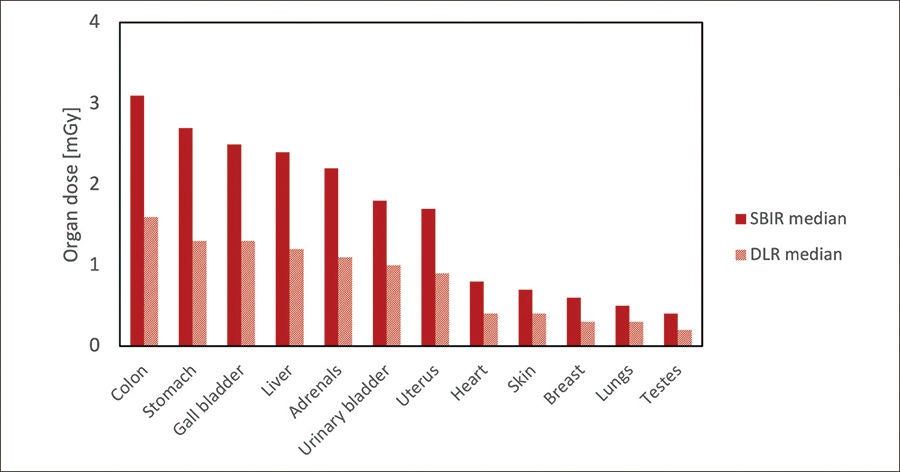 Figure 1. Organ-specific dose value comparison between DLR and SBIR. The use of DLR provides the potential for a 52% reduction in volume CT dose index and a mean of 53% in organ-specific reductions. Figure adapted from reference (Brady et al. 2021).
Reference
Brady et al. | Improving Image Quality and Reducing Radiation Dose for Pediatric CT by Using Deep Learning Reconstruction | Radiology | (2021)
https://pubmed.ncbi.nlm.nih.gov/33201790/
Deep Learning Reconstruction CT: low-dose, high-quality, and high-speed
Deep Learning Reconstruction (DLR) in CT is a promising application of artifi cial intelligence in radiology because it has the potential to improve image quality and radiological preference, as well as reduce patient radiation dose.
The review article of McLeavy et al. discusses the clinical advantages of DLR over conventional image reconstruction techniques such as the Hybrid Iterative Reconstruction (HIR). The authors are affi liated with Leighton Hospital in Crewe which was one of the fi rst institutions in the UK to use Advanced intelligent Clear-IQ Engine (AiCE) in a clinical setting. In this institution, DLR was used to develop specifi c protocols that achieve either ultra-low dose scans without a penalty in image quality or ultra-high image quality without increasing radiation dose.
Examples shown in this article:
- Volume CT pulmonary angiography with AiCE on pregnant women results in an eff ective dose of only 0.2 mSv. This is equivalent to 10 chest radiographs.
- A dual-phase and pelvis CT performed on pediatric trauma patients results in only 0.8 mSv without a compromise in the signal and contrast-to-noise ratio. A case illustration from this institution is provided in Figure 1.
- A CT scan of the urinary tract (kidney, ureter, and bladder (KUB)) using DLR with additional metal artifact reduction software reduced beam hardening in the pelvis. This exam resulted in an eff ective dose of only 1 mSv, an 84% dose reduction compared to HIR, without degrading image quality.
- Whereas a plain radiograph of the abdomen and pelvis has an eff ective dose of 1.4 mSv, the dose from CT scans of the entire urinary tract performed in this institution using DLR was only 1.2 mSv. This corresponds to 83% less radiation dose than the national dose levels.
Other examples of dose reductions in COVID-19, coronary artery disease, bariatric and oncology patients were also demonstrated.
In addition to ultra-low-dose protocols, DLR can be used to produce ultra-high-quality images, while still achieving dose reductions when compared to traditional reconstruction methods. In both cases, DLR off ers a high reconstruction speed.
In conclusion, DLR is the future in CT reconstruction as it provides the elusive triad of low dose, high quality, and high speed.
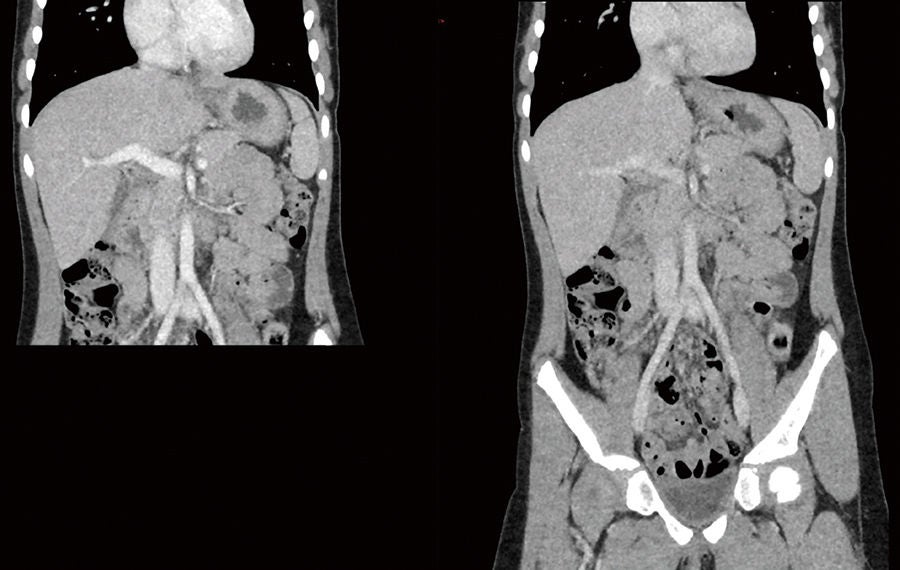 Figure 1. Dual-phase CT performed on a 7-year-old patient with suspected pancreatic trauma. Left: Coronal image from an arterial phase acquisition of the abdomen reconstructed with AiCE (0.3 mSv). Right: Coronal image from a portal venous phase acquisition of the abdomen and pelvis reconstructed with AiCE (0.5 mSv).
Reference
McLeavy et al. | The future of CT: deep learning reconstruction | Clin Radiol. (2021)
https://pubmed.ncbi.nlm.nih.gov/33637310/
CT
- Nakamura et al. | Diagnostic value of deep learning reconstruction for radiation dose reduction at abdominal ultra-high-resolution CT | European Radiology | (2021)
https://pubmed.ncbi.nlm.nih.gov/33389036/ - Matsukiyo et al. | Deep learning-based and hybrid-type iterative reconstructions for CT: comparison of capability for quantitative and qualitative image quality improvements and small vessel evaluation at dynamic CE-abdominal CT with ultra-high and standard resolutions | Jpn J Radiol | (2021)
https://pubmed.ncbi.nlm.nih.gov/33037956/ - Greffier et al. | Comparison of two versions of a deep learning image reconstruction algorithm on CT image quality and dose reduction: A phantom study | Medical Physics | (2021)
https://pubmed.ncbi.nlm.nih.gov/34418110/ - Greffier at al. | Comparison of two deep learning image reconstruction algorithms in chest CT images: A task-based image quality assessment on phantom data | Diagn Interv Imaging | (2021)
https://pubmed.ncbi.nlm.nih.gov/34493475/ - Brady et al. | Improving Image Quality and Reducing Radiation Dose for Pediatric CT by Using Deep Learning Reconstruction | Radiology | (2021)
https://pubmed.ncbi.nlm.nih.gov/33201790/ - McLeavy et al. | The future of CT: deep learning reconstruction | Clin Radiol. (2021)
https://pubmed.ncbi.nlm.nih.gov/33637310/ - Bernard et al. | Deep learning reconstruction versus iterative reconstruction for cardiac CT angiography in a stroke imaging protocol: reduced radiation dose and improved image quality. | Quant Imaging Med Surg. (2021)
https://pubmed.ncbi.nlm.nih.gov/33392038/ - Higaki et al. | Deep Learning Reconstruction at CT: Phantom Study of the Image Characteristics | Academic Radiology | (2020)
https://pubmed.ncbi.nlm.nih.gov/31818389/ - Akagi et al. | Deep learning reconstruction of equilibrium phase CT images in obese patients | Eur J Radiol | (2020)
https://pubmed.ncbi.nlm.nih.gov/33152626/ - Singh et al. | Image Quality and Lesion Detection on Deep Learning Reconstruction and Iterative Reconstruction of Submillisievert Chest and Abdominal CT | AJR Am J Roentgenol | (2020)
https://pubmed.ncbi.nlm.nih.gov/31967501/ - Lenfant et al. | Deep Learning Versus Iterative Reconstruction for CT Pulmonary Angiography in the Emergency Setting: Improved Image Quality and Reduced Radiation Dose | Diagnostics (2020)
https://pubmed.ncbi.nlm.nih.gov/32759874/ - Nakamura et al.| Possibility of Deep Learning in Medical Imaging Focusing Improvement of Computed Tomography Image Quality | J Comput Assist Tomogr (2019)
https://pubmed.ncbi.nlm.nih.gov/31789682/ - Higaki et al. | Improvement of image quality at CT and MRI using deep learning | Japanese Journal of Radiology (2019)
https://pubmed.ncbi.nlm.nih.gov/30498876/ - Nakamura et al. | Diagnostic value of deep learning reconstruction for radiation dose reduction at abdominal ultra-high-resolution CT | Eur Radiol (2021)
https://pubmed.ncbi.nlm.nih.gov/33389036/ - Urikura et al. | Deep learning-based reconstruction in ultra-highresolution computed tomography: Can image noise caused by high definition detector and the miniaturization of matrix element size be improved? | Phys Med. (2021)
https://pubmed.ncbi.nlm.nih.gov/33453504/ - Matsukiyo et al. | Deep learning-based and hybrid-type iterative reconstructions for CT: comparison of capability for quantitative and qualitative image quality improvements and small vessel evaluation at dynamic CE-abdominal CT with ultra-high and standard resolutions | Jpn J Radiol (2021)
https://pubmed.ncbi.nlm.nih.gov/33037956/ - Tamura et al. | Superior objective and subjective image quality of deep learning reconstruction for low-dose abdominal CT imaging in comparison with model-based iterative reconstruction and filtered back projection | Br J Radiol. (2021)
https://pubmed.ncbi.nlm.nih.gov/34142867/ - Narita et al. | Deep learning reconstruction of drip-infusion cholangiography acquired with ultra-high-resolution computed tomography | Abdom Radiol (NY) 2020
https://www.ncbi.nlm.nih.gov/pubmed/32248261 - Tatsugami et al. | Deep learning–based image restoration algorithm for coronary CT angiography | Eur Radiol. (2019)
https://pubmed.ncbi.nlm.nih.gov/30963270
Social Media


