


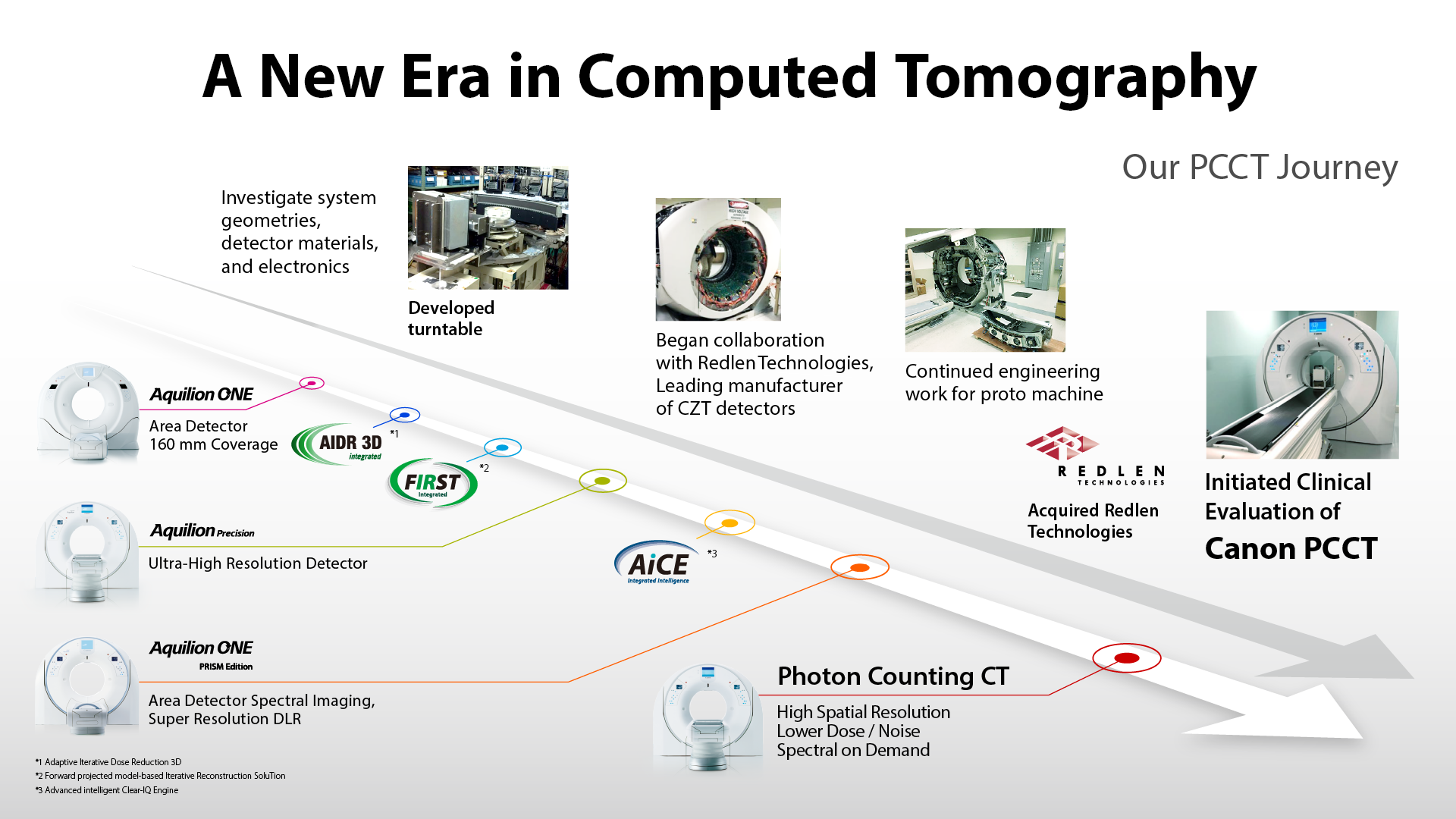
Since its inception in 1971, the dramatic evolution of Computed Tomography (CT) has led to the steady growth of CT’s role in patient care.
Canon has pioneered many of the technological innovations defining the clinical expansion of CT, such as Area Detectors, Ultra-High Resolution, and Deep Learning Reconstruction. In partnership with Redlen Technologies Inc. (Redlen), a Canon group company, the global leader in photon counting detector design and manufacturing, Canon is currently developing a Photon Counting CT (PCCT) with the potential to improve visualization of small structures and enhance tissue characterization.
Our vision is to use Redlen’s state-of-the-art Photon Counting CT technology empowered by Canon’s leading advancements in system, software, and image reconstruction to improve the quality of medical diagnosis for all patients worldwide.
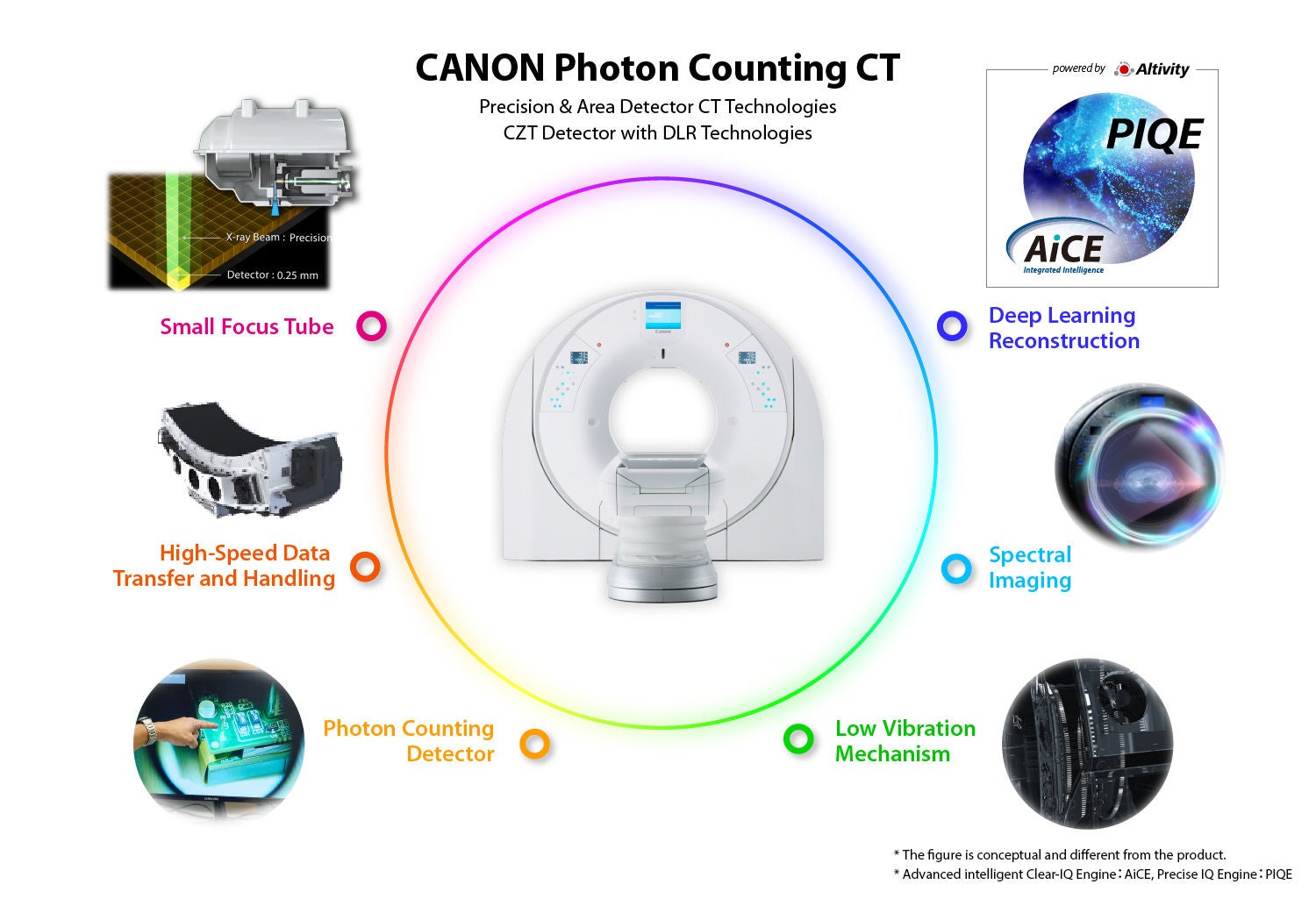
CANON'S PHOTON COUNTING CT
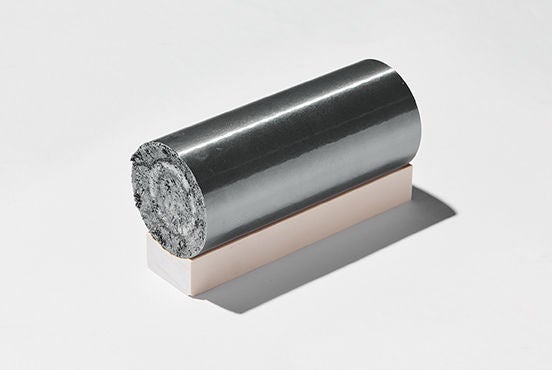
WHAT IS PHOTON COUNTING CT?
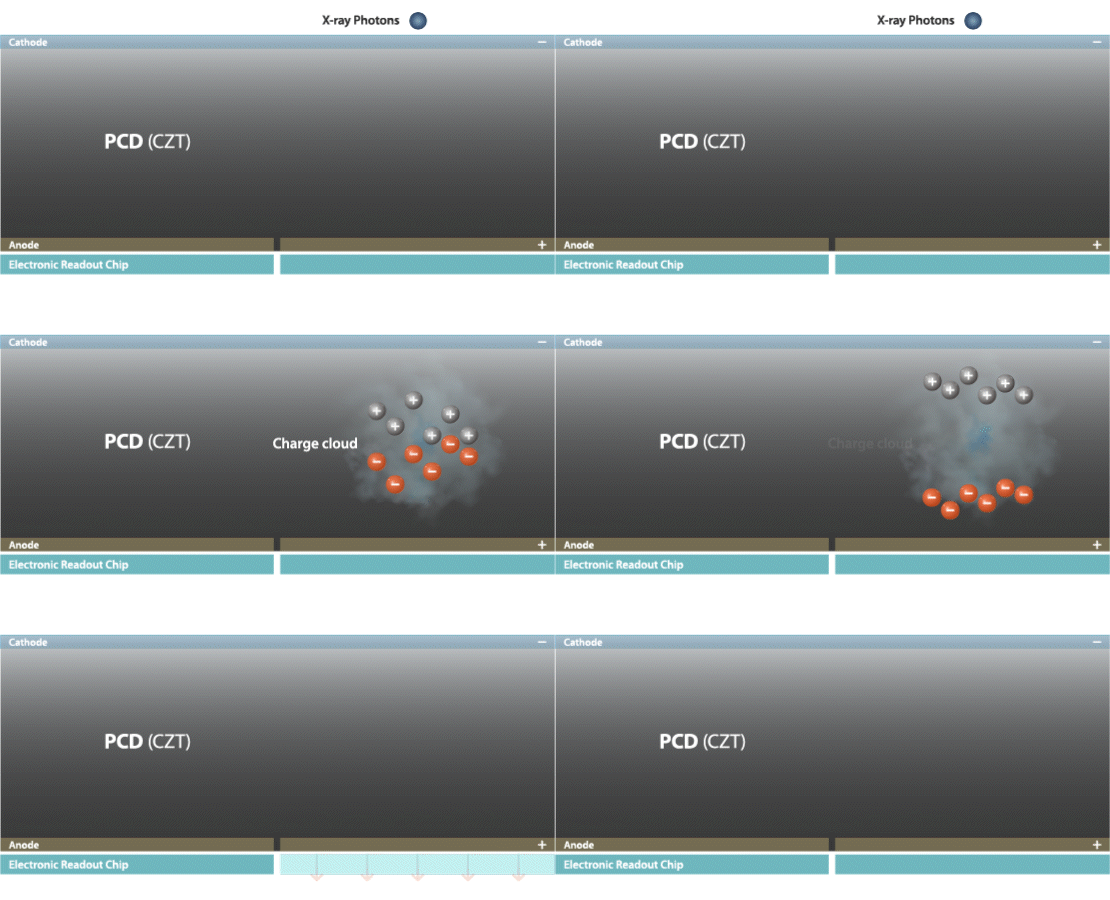
WHAT IS THE MAIN DIFFERENCE OF PHOTON COUNTING FROM CONVENTIONAL CT?
BENEFITS OF CANON’S PCCT: IMAGE QUALITY
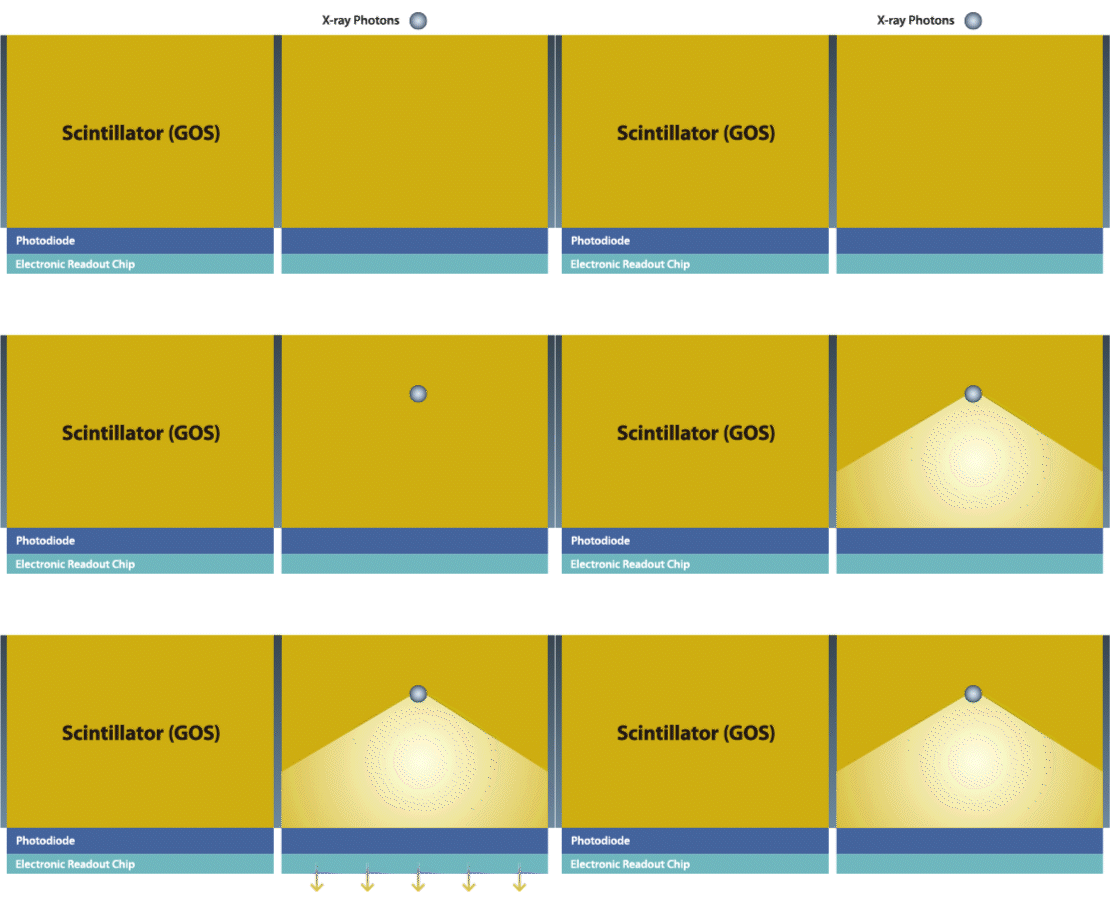
For more optimal dose efficiency, detectors should have as much active area capturing photons as possible. In conventional EIDs, light in one detector pixel can scatter into a neighboring pixel, a phenomenon called optical crosstalk that reduces spatial resolution. Because of this, EIDs require a reflector of finite thickness between the scintillator pixels to prevent crosstalk. However, the presence of this reflector reduces the active area of the detector and, thus, its dose efficiency, especially for small-sized detector pixels. Because PCCT doesn’t use a scintillator, there is no need for reflective material between detector pixels. This greatly improves the dose efficiency of the detector, allowing for smaller detector pixel sizes without dose penalty.
PCCT also overcomes a major disadvantage of EID: electronic noise. An EID’s electronic noise is unavoidably combined with true signal into the detector output. When the number of photons is low, electronic noise becomes dominant, degrading image quality. With PCCT, electronic noise from the detector registers below the threshold of lowest energy bin and is thus discarded. In this way, PCCT effectively eliminates electronic noise, which improves image quality.
BENEFITS OF CANON’S PCCT: SPECTRAL
PCCT enables Spectral Imaging with every scan for routine material decomposition. Canon’s exclusive advances in Spectral reconstruction have given Canon unique insight into minimizing noise and maximizing spectral information from PCCT. Because the thresholds for the energy bins are configurable, PCCT can also allow for imaging that targets specific K-edge energies, from common contrast agents, such as iodine and gadolinium, to novel nanoparticles such as gold.
BENEFITS OF CANON'S PCCT: ULTRA-HIGH RESOLUTION (UHR)
THE ADVANTAGE OF REDLEN, A CANON GROUP COMPANY

Scientific papers
- H. Kuno, T. Hiyama, T. Sasaki et al. Imaging-detected extranodal extension in head and neck cancer: clinical implications, diagnostic criteria, and the potential of photon-counting detector CT. Jpn J Radiol. 2025 Oct 16. doi: 10.1007/s11604-025-01894-3. Online ahead of print. PMID: 41099987
- T. Sasaki, H. Kuno, K. Nomura, Y. Muramatsu, K. Aokage, J. Samejima, T. Taki, E. Goto, M. Wakabayashi, H. Furuya, H. Taguchi, T. Kobayashi.CZT-based photon-counting-detector CT with deep-learning reconstruction: image quality and diagnostic confidence for lung tumor assessment. Jpn J Radiol. 2025 Mar 7. doi: 10.1007/s11604-025-01759-9. Online ahead of print. PMID: 40053285
- Lee D, Zhan X, Tai WY, Zbijewski W, Taguchi K. Improving model-data mismatch for photon-counting detector model using global and local model parameters. Med Phys. 2023 Dec 8. doi: 10.1002/mp.16883. Epub ahead of print. PMID: 38064641.
- Zhan X, Zhang R, Niu X, Hein I, Budden B, Wu S, Markov N, Clarke C, Qiang Y, Taguchi H, Nomura K, Muramatsu Y, Yu Z, Kobayashi T, Thompson R, Miyazaki H, Nakai H. Comprehensive evaluations of a prototype full field-of-view photon counting CT system through phantom studies. Phys Med Biol. 2023 Aug 14;68(17). doi: 10.1088/1361-6560/acebb3. PMID: 37506710.
- Schiebler ML, Jinzaki M, Yanagawa M, Pourmorteza A, Yamada Y, Kato Y, Wada N, Schaefer-Prokop C, Dousset V, Tomiyama N, Prokop M, Lima JA, Hatabu H. Future Applications of Cardiothoracic CT. Radiology. 2025 Jun;315(3):e240085. doi: 10.1148/radiol.240085. PMID: 40492912; PMCID: PMC12207641.
- Liu LP, Mei K, Sharma S, Ross S, Halliburton SS, Thompson R, Akino N, Dhanaliwala AH, Roshkovan L, Litt HI, Noël PB. Obese patient imaging: Potential dose reduction with photon-counting CT. J Appl Clin Med Phys. 2026 Aug;27(8):e70720. doi: 10.1002/acm2.70720. PMID: 42507330; PMCID: PMC13404245.
- Mei K, Roshkovan L, Halliburton SS, Sharma S, Ross S, Yu Z, Thompson R, Liu LP, Dhanaliwala AH, Litt HI, Noël PB. Evaluation of a CZT-based photon-counting detector CT prototype for low-dose lung cancer screening using patient-specific lung phantoms. Research Square [Preprint]. 2026 Jul 9. rs.3.rs-9473696. doi:10.21203/rs.3.rs-9473696/v1. PMID: 42466424; PMCID: PMC13370630
- Mei K, Roshkovan L, Liu LP, Halliburton SS, Sharma S, Ross S, Stroud T, Akino N, Yu Z, Thompson R, Dhanaliwala AH, Litt HI, Noël PB. Deep Learning Reconstruction for Ultra-High-Resolution Photon-Counting CT of the Lung: Image Quality and Texture Characterization. medRxiv [Preprint]. 2026. doi:10.64898/2026.09.04.26361840
Conference presentations
- T. Hiyama et al. A Practical Guide to Spectral, Subtraction, and Photon-Counting CT in Head and Neck Cancer Staging. RSNA 2026
- F. Tatsugami et al. Super-High-Resolution Photon-Counting CT with Deep Learning Reconstruction: From Phantom Evaluation to Clinical Applications. RSNA 2026
- Y. Nakamura et al. Utility of CZT-based photon counting detector CT for hepatic dynamic CT. ECR 2026
- S. Maeda et al. Clinical value of CZT-based photon-counting detector CT in hepatic dynamic CT in overweight patients. ECR 2026
- F. Tatsugami et al. Impact of Photon-Counting Detector CT on Visualization of the Adamkiewicz Artery Using Super-High-Resolution Mode with Deep Learning Reconstruction: A First Experience. RSNA 2025
- T. Higaki et al. Maximizing Image Quality Through the Synergy of High-Resolution Photon-Counting Detector CT and Deep Learning Reconstruction: A Coronary Phantom Study. RSNA 2025
- T. Sasaki et al. Quantitative Analysis of Pulmonary Emphysema Using Electron Density Images from Photon-Counting Detector CT: Correlation with Pulmonary Function Tests. RSNA 2025
- Kai Mei, Shobhit Sharma, Leening P. Liu, Leonid Roshkovan, Steven Ross, Ali H. Dhanaliwala, Sandra S. Halliburton, Naruomi Akino, Zhou Yu, Richard Thompson, Peter B. Noël.. Photon-Counting Detector CT and Deep Learning Reconstruction in Lung Lesion Assessment. RSNA 2025
- Leening P. Liu, Kai Mei, Shobhit Sharma, Steven Ross, Sandra S. Halliburton, Naruomi Akino, Ali H. Dhanaliwala, Leonid Roshkovan, Peter B. Noël. Assessing the Utility of Photon-Counting CT in Obese Patients. RSNA 2025
- Fong Chi Ho, Kai Mei, Shobhit Sharma, Zhou Yu, Sandra S. Halliburton, Steven Ross, Leening P. Liu, Peter B. Noël, Ehsan Samei, Ehsan Abadi. Task-specific Evaluation of Photon-Counting CT Using a 3D-Printed Anthropomorphic Lung Phantom with COPD Pathology. RSNA 2025
- Yuxin Sun et al. Use of Dark Attenuation Oral Contrast Agent Improves Delineation of Thin Structures at Ultra-High Resolution and Photon-Counting Detector CT. RSNA 2025
- Gisell Ruiz. Association between Detectability Index and Volumetric Accuracy in Low-Dose Energy-Integrating and Photon-Counting CT
- Gisell Ruiz et al. Evaluation of Reconstruction Kernels and Resolution Techniques for Volumetric Accuracy of Ground-Glass Opacity Nodules in Low-Dose Photon-Counting CT. RSNA 2025
- W. Y. Tai et al. Impact of Scatter on Phantom-based Water Pathlength Calibration in Photon-Counting CT. 2025 IEEE NPSS.
- Leening P. Liu, Kai Mei, Shobhit Sharma, Steven Ross, Sandra S. Halliburton, Naruomi Akino, Ali H. Dhanaliwala, Leonid Roshkovan, Peter B. Noël. . Improving Diagnostic Imaging for Obese Populations: Dose Efficiency of PCCT. IEEE MIC 2025.
- Y. Nakamura et al. Utility of CZT-based photon counting detector CT for an abdominal thin-slice non-contrast CT images in comparison with energy integrating detector CT. ECR 2025
- Y. Nakamura et al. Utility of virtual non-contrast images derived from CZT-based photon counting detector CT in comparison with true non-contrast images. ECT 2025
- H. Kuno et al. Imaging-detected Extranodal Extension in Head and Neck Cancer: Clinical Implications and Diagnostic Criteria in the Era of High-Resolution Imaging including Photon-Counting Detector CT. RSNA 2024
- T. Sasaki et al. CZT-based Photon-Counting-Detector CT with Deep-Learning Reconstruction: Image Quality and Diagnostic Confidence for Lung Tumor Assessment. RSNA 2024
- K. Nomura et al. Sharpness Evaluation of Chest Multi Planar Reconstruction Images with Normal and Super High-resolution Mode of CZT-Based Photon-counting Detector CT. RSNA 2024
- A. Pourmorteza et al. Dose-Efficient Characterization of Coronary Artery Plaques with a Prototype CdZnTe-Based Photon-Counting CT Scanner. SPIE 2024
- A. Pourmorteza et al. Iodine Quantification with a CdZnTe Clinical Prototype Photon-Counting Scanner at Reduced Radiation Dose: Initial Cardiac Phantom Results, ECR 2024
- K. Mei, L. Roshkovan, S. Sharma, S. Ross, S. Wu, Z. Yu, R. Thompson, P. Noël. Ultra-low-dose photon-counting CT: Assessing stability of radiomics features with a patient-based lung phantom. ECR 2024
- S. Mochinaga et al. First Results of Electron Density Quantification with CZT-based Photon Counting Detector CT. ECR 2024
- W. Fukumoto et al. Comparison of newly developed CZT-based Photon Counting Detector CT (PCD-CT) and Ultra-High-Resolution CT (U-HRCT) for measuring airway dimensions: A phantom study. ECR 2024
- K. Yokomachi et al. Physical characteristics in slice direction using a newly developed CZT-based Photon-Counting Detector CT. ECR 2024
- Y. Nakamura et al. Accuracy of CT values on virtual monochromatic images of CZT-based Photon Counting Detector CT: comparison with dual-energy CT using energy integrating detector in a phantom model. ECR 2024
- T. Higaki et al. Utility of multi-energy mode of CZT-based Photon Counting Detector CT for coronary CT angiography: A structured phantom study. ECR 2024
- D. Lee et al. Advanced Photon-Counting Detector Simulator with a Count-Rate-Dependent Mapping Operator and a Pixel-to-Pixel Variation Generator. IEEE MSS MIC 2023
- A. Pourmorteza et al. Dose-efficient Ultra-high-resolution imaging of coronary stents with a CdZnTe-based clinical prototype photon- counting scanner. RSNA 2023
- K. L. Boedeker et al. Technical Performance of Super Resolution Deep Learning Reconstruction Algorithm on a Wide Area, Conventional Energy-Integrating Detector vs and a Photon-Counting Computed Tomography System with Conventional Reconstruction Algorithms. RSNA 2023
- T. Sasaki et al. CT Imaging of Lung Cancer: Exploring the Clinical Potential of CZT-based Photon Counting Detector CT. RSNA 2023
- K. Hirayama et al. Super-high-resolution abdominal imaging using CZT based photon counting CT with deep learning reconstruction: quantitative study and first clinical impression. RSNA 2023
- K. Nomura et al. Super-high-resolution chest imaging using CZT-based photon counting CT: performance characterization and first clinical trial. RSNA 2023
- S. Mochinaga et al. High z-axis resolution imaging using CZT based photon counting CT: quantitative study and first clinical trial. RSNA 2023
- Kai Mei, Shobhit Sharma, Leonid Roshkovan, Tom Labno, Steven Ross, Zhou Yu, Peter B. Noël. Evaluation of a prototype photon-counting CT for pulmonary imaging using patient-based lung phantoms. RSNA 2023
- S. Kondo et al. Visualization of simulated small vessels on photon counting detector CT: comparison with energy integrating CT in a phantom model. RSNA 2023
- T. Higaki et al. Improving spatial resolution in coronary CT angiography with photon counting detector CT: A structured phantom study. RSNA 2023
- T. Higaki et al. Noise reduction in coronary CT angiography with photon counting detector CT: A structured phantom study. RSNA 2023
- F. Tatsugami et al. Coronary Artery Calcium Volume Measurement: A Comparison between Photon-Counting CT and Ultra-High-Resolution CT using a Cardiac CT Calibration Phantom. RSNA 2023
- K. Nomura et al. Basic Image Quality Evaluation of New Platform Prototype Photon Counting CT. JRC 2023
- X. Zhan et al. Spectral imaging performance evaluation for a prototype full-size photon counting CT system at clinical dose levels. JRC 2023
- R. Zhang et al. Quantitative image quality comparison between normal resolution and super high resolution modes of a clinical prototype photon counting CT system. JRC 2023
- T.W. Holmes et al. Pediatric head and neck imaging with a CZT-based photon-counting CT scanner: initial image quality evaluation. ECR 2023
- K. Nomura et al. Comparison of CT image quality for different sized phantom between prototype full-size photon counting and conventional CT systems: CT number, image noise and artifact. ECR 2023
- Edgar Salazar et al. Evaluation of a prototype photon-counting CT for low-dose pulmonary imaging using patient-based lung phantom. ECR 2023
- X. Zhan et al. A study of cross-talk effect in pixelated photon counting detectors and impact to system imaging performance. SPIE 2023
- Donghyeon Lee et al. Photon-Counting Detector Model Using Local Parameters for Pixel-to-Pixel Variation. SPIE 2023
- W. Yang Tai et al. Effects of Bowtie Scatter on Material Decomposition in Photon-Counting CT. SPIE 2023
- R. Zhang et al. Quantitative Image Quality Comparison between Photon Counting and Conventional CT Systems: Contrast-to-Noise Ratio. RSNA 2022
- K. L. Boedeker et al. Low Contrast Detectability Comparison Between a Prototype Photon Counting Computed Tomography System and Conventional CT system Across a Range of Attenuation Levels. RSNA 2022
- Xiaohui Z et al. Quantitative image quality evaluation for a prototype photon counting CT through phantom studies: Noise, Resolution and Quantitative Accuracy. CERN SpecXray 2022
- A. Pourmorteza et al. First experience with a clinical prototype CZT-based PCCT scanner: applications in low-dose lung cancer screening. CERN SpecXray 2022
- Xiaohui Z et al. Phantom imaging evaluations of a prototype CZT based photon counting system. ECR 2022
- K. Nomura et al. Quantitative image quality comparison between a prototype full-size photon counting CT system and conventional CT systems with energy integrating detectors. ECR 2022
- T. W. Holmes et al. Low-Dose Lung Cancer Screening with a Novel CZT Photon-Counting CT Prototype: A Phantom Study. ECR 2022
- Y. Suzuki et al. Physics Performance Evaluation of Prototype Photon Counting CT: Basic Image Quality Evaluation. JRC 2022
- K. Nomura et al. Physics Performance Evaluation of Prototype Photon Counting CT: Quantitative Evaluation. JRC 2022
- Y. Muramatsu et al. Physics Performance Evaluation of Prototype Photon Counting CT: Large-phantom Evaluation. JRC 2022
- Xiaohui Z et al. First results from a prototype full-size photon counting CT system: counting and spectral imaging performance at clinical dose levels. RSNA 2021
- K. Nomura et al. Quantitative image quality comparison between photon counting and conventional CT systems: noise, resolution and quantitative accuracy. RSNA 2021
- E. J. Smit et al. Early clinical experiences for chest imaging with a new photon counting CT system combining cadmium zinc telluride detectors and super-high resolution deep-learning image reconstruction. ECR 2024
- I. Sechopoulos et al. Evaluation of lung nodule volumes using conventional CT and CdZnTe-photon counting CT with hybrid and deep learning reconstruction methods. RSNA 2024
- E. J. Smit et al. Initial clinical experiences of a novel photon counting system combining cadmium zinc telluride detectors and super-high resolution deep-learning image reconstruction. RSNA 2024
- Paulo R Costa et al. Evaluation of Reconstruction Kernels and Resolution Techniques for Volumetric Accuracy of Ground-Glass Opacity Nodules in Low-Dose Photon-Counting CT. RSNA 2025
- Paulo R Costa et al. Association Between Detectability Index and Volumetric Accuracy in Low-Dose Energy Integrating and Photon-Counting CT. RSNA 2025
- K. Salah et al. Photon-Counting CT for Aortitis: Integrated Deep Learning Reconstruction for Both Spectral and Ultra-high Resolution Imaging. ERASMUS 2026
- K. Salah et al. Ultra-High Resolution Photon-Counting CT for Coronary Angiography: initial results with a novel cadmium zinc telluride detector combined with deep-learning image reconstruction. ECR 2026
- Paulo R. Costa et al. DOSE AND NOISE TEXTURE EFFECTS ON LUNG NODULE VOLUMETRY IN PHOTON COUNTING CT. ECR 2026
- M. Remy-Jardin et al. SMALL-AIRWAY IMAGING WITH CZT-BASED PHOTON-COUNTING DETECTOR CT: A two-year clinical experience. Fleischner 2026
- M. Remy-Jardin et al. Differentiating fibrosis from inflammation in patients with systemic sclerosis with newly developed ground glass opacities: does UHR imaging with cadmium-zinc-telluride (CTZ) photon counting CT alter classification? RSNA 2026
- Mei K, Sharma S, Roshkovan L, Ross S, Akino N, Liu LP, Yu Z, Halliburton SS, Thompson R, Noël PB. Photon-counting CT Imaging of Patients with >95th Percentile Waist Circumference using a 3D-printed Pancreas Model. ECR 2025
- Liu LP. Experience with a Clinical CZT Photon Counting CT Prototype. AAPM 2025
- Liu LP, Mei K, Sharma S, Ross S, Halliburton SS, Akino N, Dhanaliwala AH, Roshkovan L, Noël PB.Improving Diagnostic Imaging for Obese Populations: Dose Efficiency of PCCT MIC 2025
- Liu LP, Halliburton SS, Ross S, Dhanaliwala AH, Kneeland B, Noël PB. Reduced metal artifact and improved visualization of scaphoid fracture healing after fixation with ultra-high resolution CZT based PCCT. Erasmus 2026
- Liu LP, Halliburton SS, Ross S, Dhanaliwala AH, Noël PB. Fractured inferior vena cava filter demonstrated with CZT-based photon-counting CT. Erasmus 2026.
- Shi H, Litt H, Liu LP, Halliburton SS, Schuzer J, Noël PB. Improved IQ with Deep Learning Reconstruction (DLIR) in Full Detector Width High Resolution Counting Coronary CT. Erasmus 2026
- Liu LP, Mei K, Sharma S, Ross S, Halliburton SS, Akino N, Dhanaliwala AH, Roshkovan L, Noël PB. Assessing the Dose Efficiency of Photon-Counting CT in Obese Patients. ECR 2026.
- Mei K, Roshkovan L, Ross S, Halliburton SS, Thompson R, Dhanaliwala AH, Litt HI, Liu LP, Noël PB. Realistic Fat-Mimicking Lesions in 3D-Printed Spectral CT Phantoms for Pulmonary Imaging. ECR 2026
- Edgar Salazar, Leening P. Liu, Kai Mei, Shobhit Sharma, Tom Labno, Steven Ross, Zhou Yu, Ruola Zhang, Richard Thompson, Peter B. Noël. Evaluation of a prototype photon-counting CT for low-dose pulmonary imaging using patient-based lung phantoms. ECR 2023
- Kai Mei, Shobhit Sharma, Leonid Roshkovan, Steven Ross, Tom Labno, Zhou Yu, Richard Thompson, Peter B. Noël. Evaluation of Photon-Counting Detector CT on 3D-Printed Lung Phantom with Digital Lesions. CT Meeting 2024
- Kai Mei, Shobhit Sharma, Leonid Roshkovan, Steven Ross, Naruomi Akino, Richard Thompson, Zhou Yu, Peter B. Noël. Evaluation of a prototype photon-counting detector CT for pulmonary imaging using 3D-printed patient-based lung lesion phantoms. ISCT 2024
- Kai Mei, Shobhit Sharma, Leonid Roshkovan, Steven Ross, Naruomi Akino, Zhou Yu, Richard Thompson, Peter B. Noël. Characterization of Lung Lesions with Hybrid Lifelike Phantoms in Low-dose Photon-Counting Detector CT. RSNA 2024
- Mei K, Sharma S, Roshkovan L, Ross S, Akino N, Yu Z, Thompson R, Noël PB. Realistic 3D-Printed CT Phantoms Featuring Digital Lung Lesions for Photon-Counting Computed Tomography. RSNA 2024
- Kai Mei, Leonid Roshkovan, Shobhit Sharma, Steven Ross, John Woo, Sandra S. Halliburton, Leening P. Liu, Richard Thompson, Zhou Yu, Peter B. Noël. 3D-printed Anthropomorphic Head Phantom Featuring White and Gray Matter Structures for Evaluating CT Imaging. ECR 2025
- Shi H, Litt H, Liu LP, Halliburton SS, Schuzer J, Noël PB. Improved IQ with Deep Learning Reconstruction (DLIR) in Full Detector Width High Resolution Counting Coronary CT. ECR 2026
- Dhanaliwala AH, Liu LP, Stroud T, Kneeland B, Mei K, Thompson R, Halliburton SS, Ross S, Roshkovan L, Litt HI, Noël PB. Clinical Performance of Photon-Counting CT: Multiregional Case Experience Using an Investigational CZT-Based System. CERN SpecXRay 2026
- Litt H, Shi H, Liu LP, Halliburton SS, Schuzer J, Noël PB. Improved Image Quality with Deep Learning Image Reconstruction (DLIR) in Full Detector Width High Resolution Photon Counting Coronary CTA. NASCI 2026
Social Media


