

Good to Know on Precise IQ Engine (PIQE)
Valentin H. Prevost, PHD
WHAT?
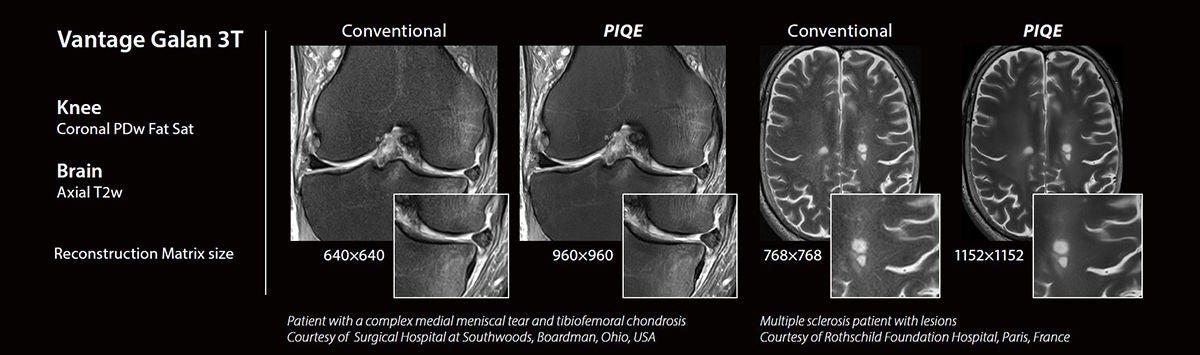
PIQE is a solution designed to increase the reconstructed matrix size, providing finer resolution while maintaining or improving SNR.
WHY?
PIQE can lead to a higher throughput and/or a better clinical confidence.
WHEN?
PIQE can be used on 2D Fast Spin Echo (FSE) sequences, at both 1.5 and 3T, especially when SNR is low but more sharpness is needed.
HOW?
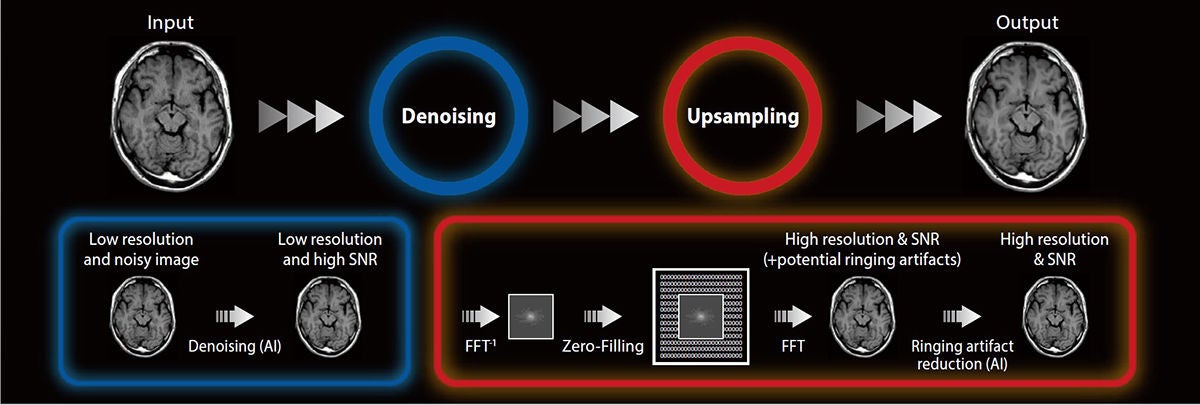
PIQE is a reconstruction tool that combines two unique steps: denoising and upsampling (see figure below). The role of the denoising step (blue circle) is to increase SNR. To do this, an AI-based algorithm (similar to the one used in Canon’s Advanced intelligent Clear-IQ Engine (AiCE) solution, explained in a previous Good to Know) is applied to selectively remove noise without affecting signal. The denoised images are then converted into k-space to proceed to the upsampling step (red circle), where the image matrix size is expanded by a zero-filling process. In addition to increasing the perceived sharpness, this high level of resolution expansion is known to create some ringing artifacts (or Gibbs Ringing) around interfaces between structures. However, PIQE incorporates a second AI-based algorithm which has been trained to detect and reduce these artifacts.
PIQE includes four adjustable parameters: (1) the multiplicative upsampling factor that is applied to both the phase and readout matrices (Zoom Ratio); (2) the denoising strength (DL Recon Adjust); (3) the blending level between denoised images and original images to retain more natural feeling (Denoise Levels); (4) the option to enhance structure contours (Edge Enhancement).
Precautions
- PIQE does not create signal that has not been acquired. Small structure information could be missed if acquisition matrix is too small.
- Because PIQE and AiCE both include denoising steps, users can not reconstruct the same image with both solutions.
- Even though PIQE denoising parameters have the same name as AiCE parameters (DL Recon Adjust, Denoise Levels), similar values or levels do not necessarily provide similar denoising results.
Tips. Tricks, and best practices
- To maximize benefit of PIQE, use Zoom ratio = 3.
- To optimize PIQE, it is recommended to start from a Canon PAS with standard settings, and then to fine tune PIQE parameters one by one (DL Recon Adjust, Denoise Levels and Edge Enh).
- PIQE reconstructions can be done retrospectively a long as raw data are accessible on the system.
Questions from the field?
Q. Is the k-space upsampling achieved with artificial intelligence?
A. No. The PIQE pipeline utilizes two deep-learning algorithms (one for denoising and another to reduce ringing artifacts). However, matrix size increase is specifically achieved by zero-filling, without the use of AI.
Q. What is the difference between FineRecon and the PIQE upsampling step?
A. FineRecon is a zero-filling reconstruction tool limited to an upsampling factor of 2 while PIQE upsampling can increase the matrix size by a factor up to 3 in both directions.
Q. What is the purpose of the ringing reduction step?
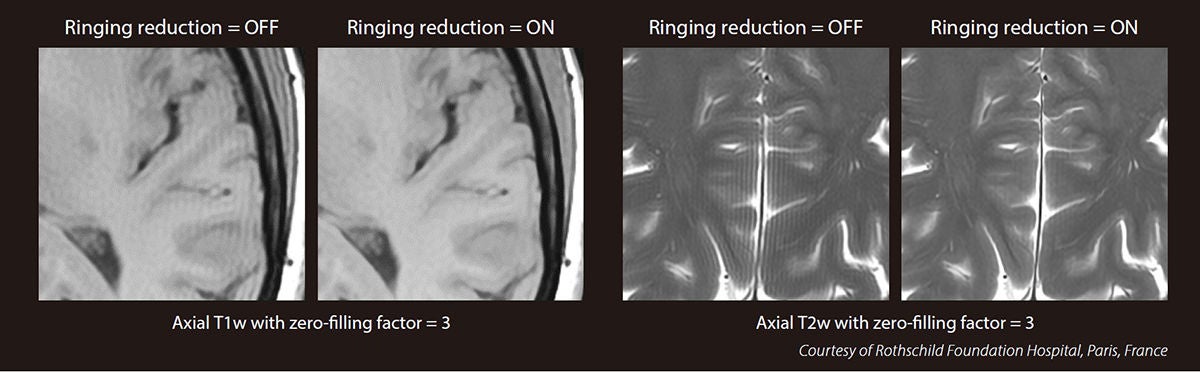
A. When higher upsampling factors are used (e.g., factor 3), ringing artifacts can appear in areas with high- contrast interfaces. Therefore, PIQE includes a specific algorithm to detect and reduce these artifacts. In the demonstration below, reconstructions have been performed with and without the ringing reduction algorithm applied:
Q. How does PIQE denoising step work?
A. PIQE denoising is an AI-based method trained to identify and remove noise from both magnitude and phase components of images, which is key in certain contexts.
Download full PDF of Good to Know on Precise IQ Engine (PIQE)
Disclaimer
Some features presented in this article may not be commercially available on all systems shown or may require the purchase of additional options. Due to local regulatory processes, some commercial features included in this publication may not be available in some countries. Please contact your local representative from Canon Medical Systems for details and the most current information.
For more infomation


Subscribe to Canon MRI Latest Information
Sign up to receive update. Be the first to know about our products and publications.
Required information

Social Media


