

Improved diagnostic confidence with
Bayesian-based CT perfusion in acute stroke
Ewoud Smit MD, PhD
Radiologist Radboud University Medical Center Nijmegen, the Netherlands

“Bayesian-based perfusion significantly improves the diagnostic confidence in our primary stroke center. With better image quality, perfusion deficits are more easily depicted, also by non-experts. We especially value that all perfusion parameter maps are now of diagnostic quality allowing for a confident distinction of perfusion patterns, where in the past diagnosis could remain uncertain because of ambiguity between these maps. This allows for a better separation into infarct core and penumbra regions.”
Patient history
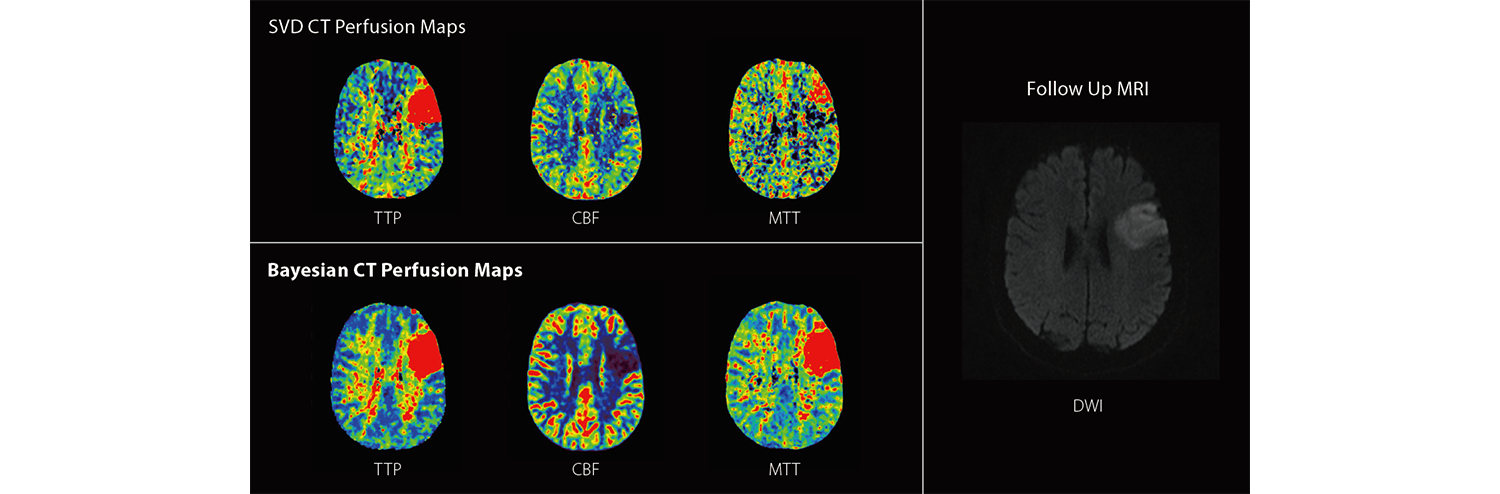
A 73-year-old patient with a history of hypertension and atrial fibrillation presented to a primary stroke center with sudden onset of aphasia. Perfusion CT imaging was performed within two hours after onset of symptoms. The Bayesian perfusion maps show an increased time to peak in the left frontal lobe, but with clear decrease of cerebral blood flow and prolonged mean transit time, characteristically consistent with an infarct core. Follow-up MR- Diffusion Weighted Imaging from day two shows an infarct in the left frontal lobe corresponding to the infarct core displayed on the Bayesian perfusion maps. Patient received intravenous thrombolysis and did not undergo an intra-arterial thrombectomy, as CT angiography did not show a proximal occlusion.
Results
Bayesian perfusion maps show high-quality resolution and clear correlation with the DWI follow up imaging, displaying an infarct core in the left frontal lobe.
Technology
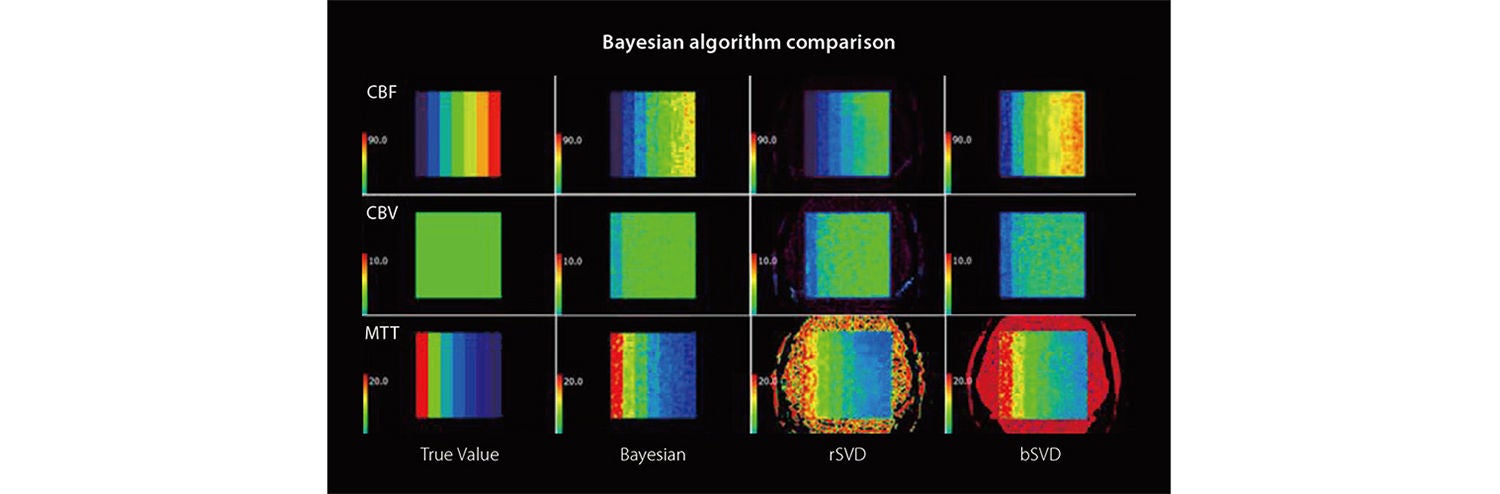
The Bayesian method is a probabilistic algorithm available within the Vitrea Advanced Visualization platform, based on the Bayes theorem. The theory combines experimental data and prior information regarding the parameters of a model (such as CBF and MTT values), to generate a robust probability distribution for these parameters*1. As a result of this probabilistic approach, maps computed using the Bayesian algorithm can help provide accurate hemodynamic parameters, even in low flow conditions, perform well at low signal-to-noise ratios and result in maps with clear visible lesion borders*2. The accuracy of the Bayesian algorithm is illustrated in the graphic below-, which utilizes a digital phantom to compare the accuracy of the Bayesian algorithm to two alternate algorithms*3.
- Mouridsen K, Friston K, Hjort N, Gyldensted L, Ostergaard L, Kiebel S.
Bayesian estimation of cerebral perfusion using a physiological model of microvasculature. NeuroImage 2006,33:570– 579. - Boutelier, T et al. Brain perfusion utilizing Bayesian modeling for the evaluation of ischemic stroke. 2020.
- Sasaki M, Kudo K, Boutelier M, Pautot F, Christensen S, Uwano I, Goodwin J, Higuchi S, Ito K, Yamashita F.
Assessment of the Accuracy of a Bayesian Estimation Algorithm for Perfusion CT by Using a Digital Phantom. Neuroradiology. 2013.
Oct;55(10):1197-203 - Adaptive Iterative Dose Reduction
- American Association of Physicists in Medicine (AAPM) Report 96, 2008.
Conclusion
The Bayesian method is less sensitive to noise and provides accurate lesion delineation, even in low flow conditions. The Bayesian method may improve diagnostic performance in cases of infarct detection.
Social Media


