

The world’s First Aquilion Exceed LB is Installed at Radiotherapy Institute Friesland
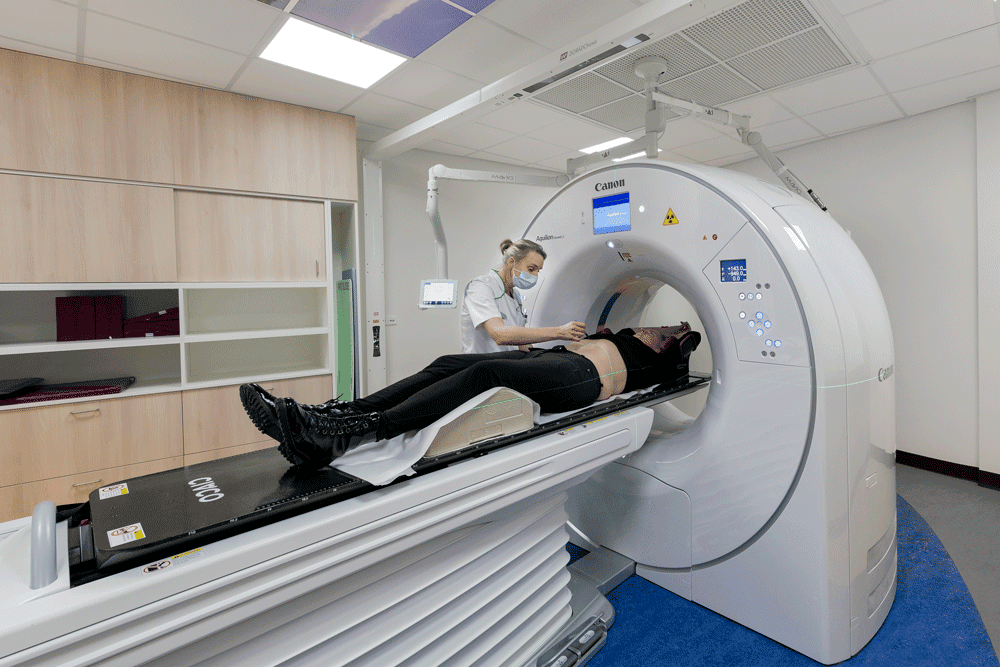
The new Aquilion Exceed LB of Canon Medical Systems has been devel-oped for a quick, smart and accurate CT simulation. With the largest gantry opening
in the industry (90 cm), the user can position patients with exceptional precision.
The Aquilion Exceed LB makes use of advanced AI image reconstruction (AiCE) for an accurate depiction of tumors and surrounding critical organs. In
combination with a true Field- of-View (FOV) of 70 cm, an extended FOV of 90 cm and a detector scope in the direction of 4 cm, the Aquilion Exceed LB
makes the work flow more accurate, faster and more efficient, without making any concessions to the image quality or the reproducibility of the position of
the patient.
VISIONS spoke with the Radiotherapeutic Institute Friesland (RIF), an independent institute where radiotherapeutic care is provided in the province of Friesland in The Netherlands.
Optimisation through man and machine
As a clinical physicist, Dr. Kaatee plays a pivotal role at RIF. As a subject matter expert, he is ‘responsible for the adequate and proper clinical
application of medical physics’, if his job could be described in one line. In practice this means that Dr. Kaatee applies his knowledge of physics,
measuring techniques and the processing and interpretation of measurement data to facilitate the work of the radiotherapist and support the
technologists as efficiently as possible.
This well-oiled system of 'man and machine' requires constant consultation and corrective adjustment to optimise the individualised care RIF offers
its patients. “However technically advanced the Aquilion Exceed LB is, it is primarily a means for us to realise our aim: the treatment of patients. In
my opinion, the crux of the treatment is the team of technologists and clinical physicists. Their expertise and skill in knowing how to use the
Aquilion Exceed LB enables me to provide the best radiotherapy,” says Radiotherapist Drs. Annelies van der Geest. “I can be totally confident that this
team will configure the equipment in the optimal way for each patient. The possibilities offered by the Aquilion Exceed LB are phenomenal,
however no single patient is standard. We therefore constantly focus on the optimisation process.”

“The service team of Canon Medical is available whenever you need them.”
Dr. Robert Kaatee, Radiotherapy Physicist.
Individualised care in addition to fantastic functionalities
Dr. Kaatee gives an example that illustrates the individualised care described by Van der Geest. “A tumour is usually depicted on an MRI scan, after
which the dose calculation is carried out on a CT scan. This means that you have to copy the target area, which is depicted on the MRI, to the CT
scan. This scan must have excellent image quality, otherwise you cannot check the match and the patient is radiated in an inefficient way. To obtain
the best scan and treatment protocols, the excellent image quality of the Aquilion Exceed LB is crucial,’’ says Dr. Kaatee.
Technologists Ragna Dik and Eddy van den Bosch, who are used to working with Canon Medical equipment, also appreciate the very high image
quality of the new system. However, the RIF team still manages to introduce improvements in this respect. For example, the team has already
optimised the head-neck scans by varying the spatial resolution and by using smart tricks to bring the 4D scans to the level required by RIF. They
always think of the ultimate objective of their treatments: to carry out a treatment with the lowest radiation level, while achieving the best possible
image quality.

“The possibilities offered by the Aquilion Exceed LB as a standard are phenomenal.”
Drs. Annelies van der Geest, Radiotherapist.
For accurate calculation of the radiation dose, it is essential that the Aquilion Exceed LB has great Hounsfield Unit accuracy, which is achieved
through Advanced intelligent Clear-IQ Engine (AiCE) protocols. The measured Hounsfield Units of the various materials in a calibration phantom
correspond well with the reference values. Another major advantage of the Aquilion Exceed LB is the fact that the radiation dose of the average
scan has been reduced by a factor of five, for example by applying Deep Learning Reconstruction.
This is an advantage that should not be underestimated, because with radiotherapy, the radiation plan is, ideally speaking, continually checked and
adjusted during the course of radiotherapy treatment if deviation from the original plan becomes too significant. This sometimes requires a new
scan. If so, a low radiation dose scan is important for the patient.
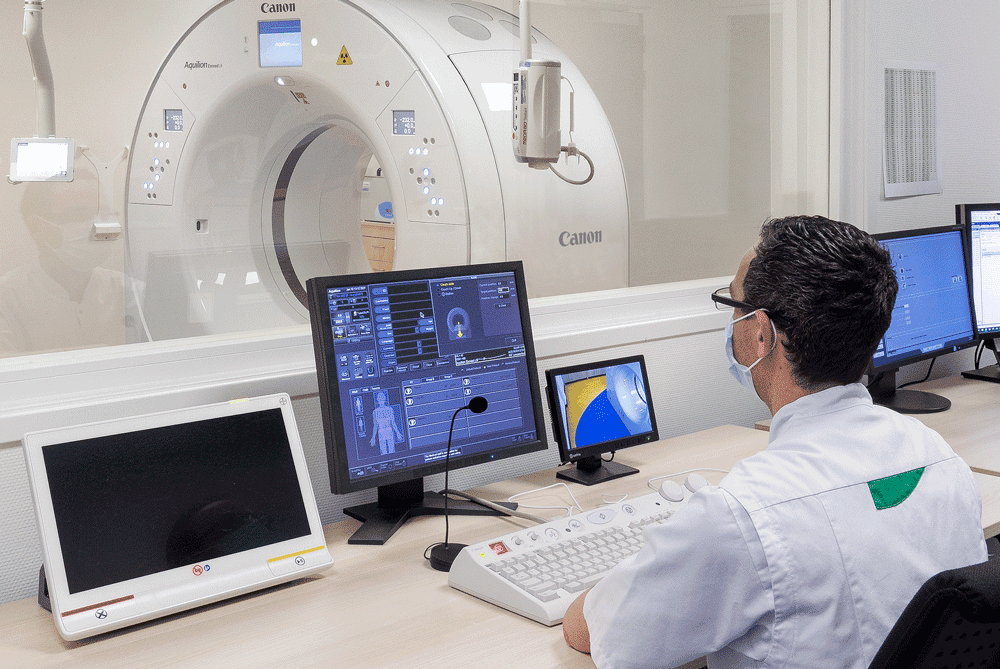
Eddy van den Bosch (Technologist) in the control room of the Aquilion Exceed LB.
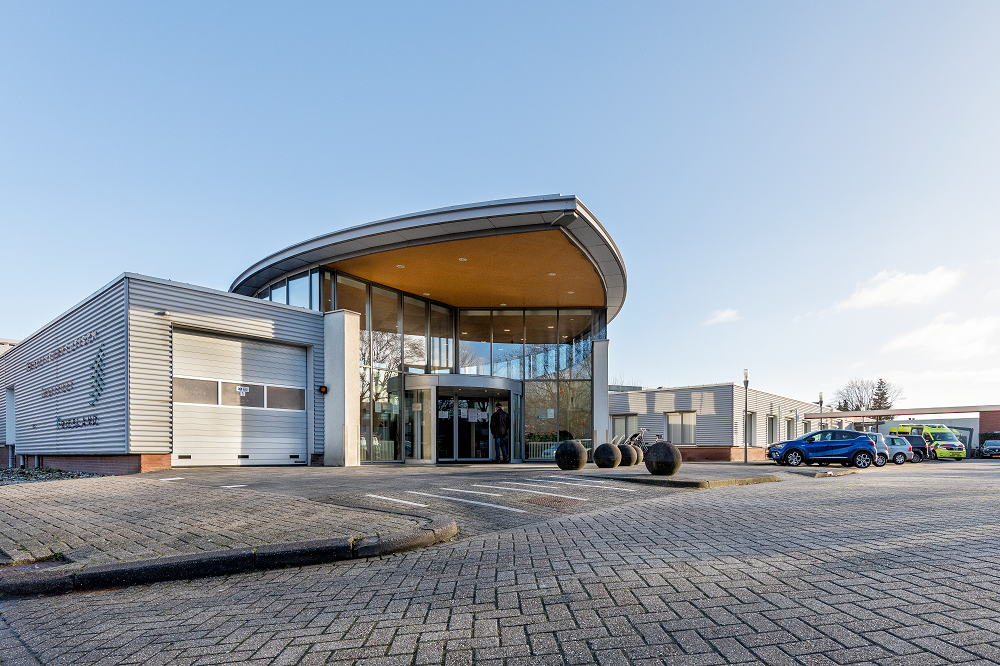
Radiotherapeutic Institute Friesland (RIF), The Netherlands.

“ The large bore (LB) of 90 cm is an indispensable feature that offers the necessary flexibility.”
Eddy van den Bosch, Technologist.
Amazing reconstruction speed
One of the main advantages in relation to other systems, is the tremendous improvement in reconstruction speed. The reconstructions of the most
advanced and frequently used 4D scans are available within a few minutes. It is also because of this time saving that 4D scans can be planned in a
more flexible way than before.
The seamless interface with the Varian Respiratory Gating system (RGSC) is also responsible for the increased efficiency of the 4D scans. During a 4D
scan, whereby the respiration signal is recorded with the Varian application, the complete signal is passed on, compared to the previous situation
whereby only the triggers of the peaks were imported.
The advantage of this is that a good 4D scan can now also be made of patients with slower respiration rates. Even patients with a very slow
respiration rate of 10 seconds can be scanned on the Aquilion Exceed LB with great accuracy.
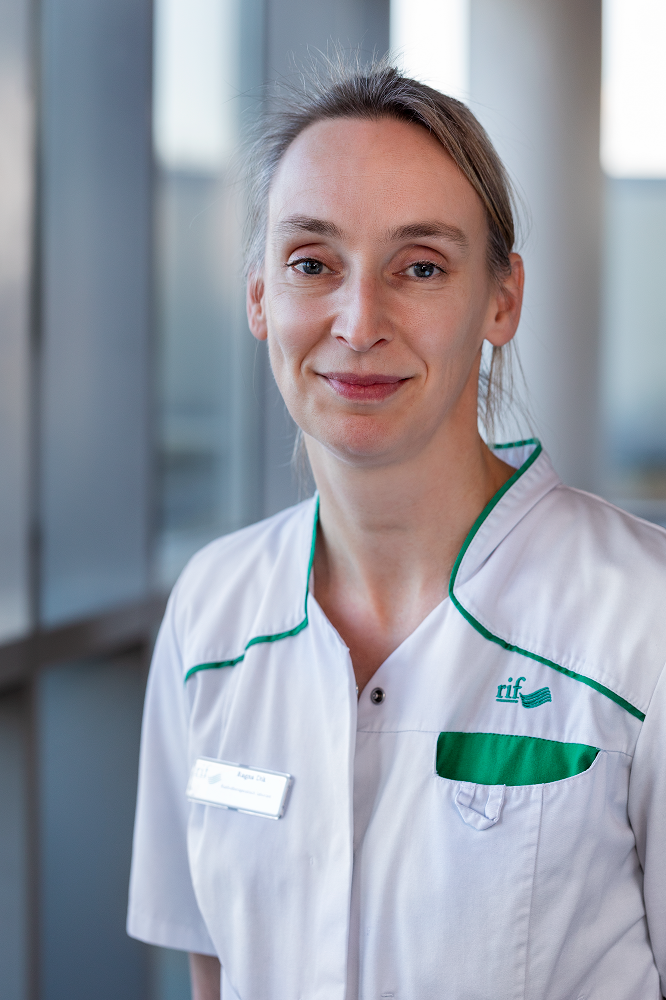
Ragna Dik, Technologist.
Advantages for the patient
Besides making life easier for the physicians, the Aquilion Exceed LB also makes the treatment more bearable for patients. Radiotherapist Drs.
Annelies van der Geest: “For me as a professional, a feature such as Single Energy Metal Artifact Reduction (SEMAR) is a marvellous way to optimally
depict the target area in the most challenging patients. However, our patients are clearly very enthusiastic about the fantastic user experience. This
experience is evident in several ways. First of all, we are available when necessary. The greatly reduced reconstruction time is largely responsible for
this. Because the reconstruction times are faster we can plan a 4D scan any time of the day.”
Moreover, it is necessary for radiotherapy patients to be positioned for the CT scan in the same way in which they will be radiated. This means that
for radiotherapy treatment for breast cancer for example, they have to raise their arms when going into the scanner. For this, the large bore of 90 cm
is an indispensable feature that offers the necessary flexibility. “Certainly if the patient is slightly claustrophobic, the advantage is considerable,” says
Eddy van den Bosch. “And in this respect the speed of the scanner is also important.”
“RIF is clearly very happy with the new scanner,” concludes Dr. Kaatee, “and the ongoing cooperation with Canon Medical Systems. The connectivity
of the Aquilion Exceed LB with hardware and software solutions such as the Varian RGSC system, Elekta Mosaiq Care Management software and the
RayStation treatment planning system is excellent. Our engineers can use the system almost blindfolded.
The Canon Medical service team are available whenever we need them, but we do not really expect to see them with this new CT system. As was
the case with our previous scanner, downtime does not apply with the Aquilion Exceed LB.” //
The content reflects information available at the time of publication and may differ from current information.
Social Media


