

Maximum Efficiency, Prioritized
Patient Safety and Increased Revenue with Canon Medical’s 4D CT Technology
Osman Ahmed, MD
Section of Vascular and Interventional Radiology
Department of Radiology University of Chicago Medical Center
Yiemeng Hoi, PhD, Dale Marek, RT(R),
Mark Hohn, Andrew Kuhls-Gilcrist, PhD, DABR
Medical Affairs, Interventional X-ray Canon Medical Systems USA, Inc.
Real visionary innovation creates technology that improves efficiency, increases diagnostic and interventional revenue, expands radiology services and simultaneously delivers high-quality care while maximizing patient safety. Canon Medical’s hybrid 4D CT system combines two powerful imaging modalities in the same room, allowing CT examinations and image-guided interventions without moving your patient to another department. This innovative solution may help you to support the expansion of complex interventional procedures, reduce treatment time, while improving throughput of other diagnostic imaging suites. Additionally, during an outbreak of communicable disease, having a hybrid 4D CT system reduces the need to transfer patients, thereby minimizing risk of exposure to both staff and patients.
Increased Radiology Revenues
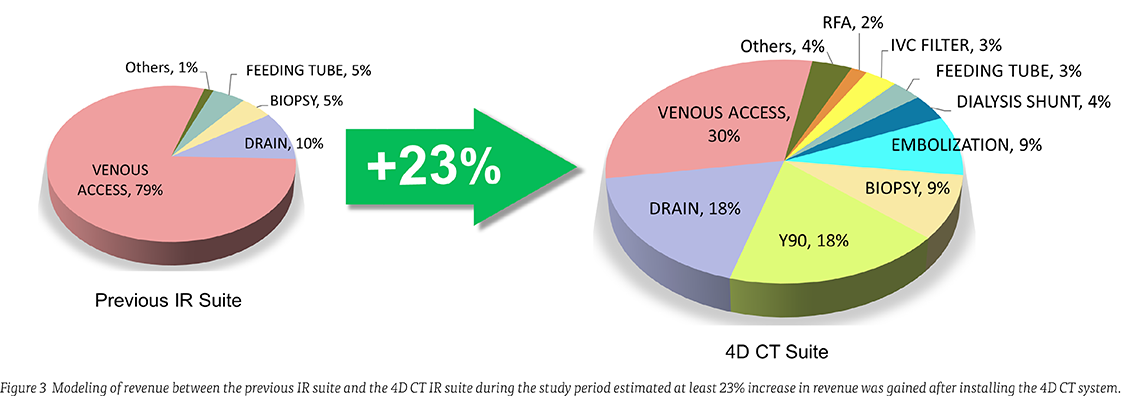
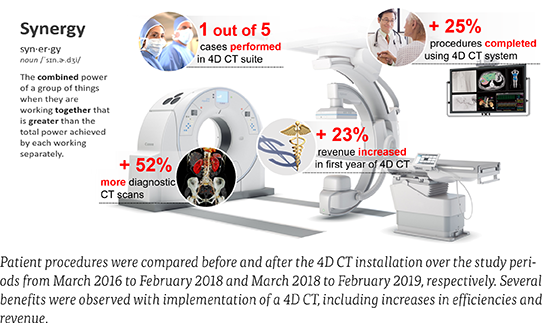
Increased procedure volumes can also translate into increased revenue. Evaluating five payor types (Medicare, Medicaid, commercial insurance, managed care programs and out-of-pocket), the total annual revenue increased 23% over the first year after implementation of the 4D CT (Figure 3) (See Appendix for analysis). The 4D CT suite expanded many new, diverse and/or high revenue interventional procedures supported by its innovative imaging technology.
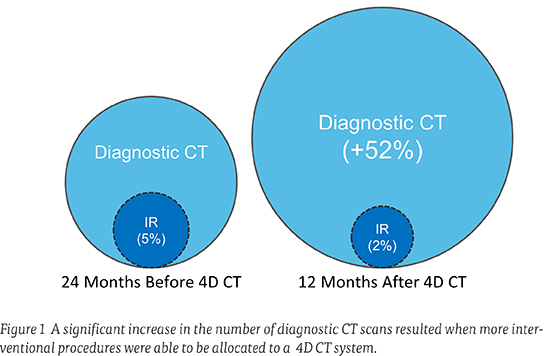
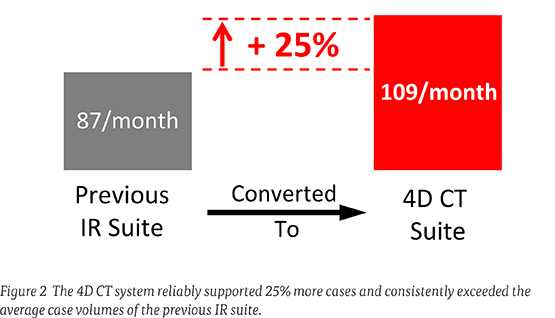
Including the increase in case volume in both diagnostic CT (+ 4692 cases/year) and 4D CT (+ 264 cases/year) suites and using the national average Medicare rates, the additional annual payments can be estimated. For example, at the low end, an additional 4692 diagnostic chest CT scans (CPT 71250) and 264 lung biopsies (CPT 32405) would add an additional annual payment of approximately $900,000. At the high end, assuming all CT scans were abdomen pelvis with contrast and all interventional procedures were transcatheter radioembolizations (CPT C 2616) would add approximately $5.1M in annual revenue. Actual increases in revenue likely fall somewhere in between the minimum and maximum estimates.
Collaborate For Better Patient Care
Canon offers a multidimensional knowledge base, dynamic customer interaction, and a robust support system of training and education to help medical teams transition and prosper within the today’s healthcare environment. Canon’s onsite accredited training program, conducted by experienced Application Specialists, provides in-depth information and experience in multi-phases of high quality training, empowering the medical team to use the system to its fullest potential.
Conclusion
The seamless integration of Canon Medical’s industry leading interventional system with best-in-class CT technology offers one versatile solution for all possible interventional needs. This innovative 4D CT system may help you to boost efficiencies, improve throughput and increase revenue of both diagnostic and interventional suites. In addition, it may also help you to maintain an appropriate level of preparedness during acute outbreak of respiratory pandemic events through minimizing risk of disease transmission and disturbances in workforce. Easily switching between CT and angiography systems in a single room setting eliminates the need to transfer the patient and medical teams between rooms, which may lessen transport accidents resulted from patient transfer, diminish nonproductive time between cases, and reduce the disinfection costs of treatment in multiple locations.
In summary, Canon Medical’s 4D CT enables you to improve your efficiency, increase diagnostic and interventional revenue, expand radiology services and simultaneously deliver high-quality care while maximizing patient safety.
Appendix
An evaluation of the total annual payments for the 4D CT suite and the previous IR suite over a study period of 36-months was performed looking at five payor types: Medicare, Medicaid, commercial insurance, managed care programs and out-of-pocket. The total annual revenue was estimated by multiplying the total payment from each payor to the national health expenditure payor mix ratio (20% Medicare, 17% Medicaid, 34% commercial insurance, 10% out-of-pocket and 19% managed care programs). Payor payments were calculated using national average Medicare rates, the Illinois Medicaid-to-Medicare fee ratio of 0.796, and the commercial payments-to-Medicare fee ratio of 2.16.7 Out-of-pocket and managed care payments were considered equivalent to commercial insurance and Medicare rates, respectively.
- References
- Feinberg N, et al. J Vasc Interv Radiol. 2020 Oct 8;S1051-0443(20)30574-
- Inaba Y, et al. AJR Am J Roentgenol. 2000 Apr;174(4):955-61
- Takayasu K, et al. AJR Am J Roentgenol. 2001 Mar;176(3):681-8
- Toyoda H, et al. AJR 2009; 192:766–774
- Piron L, et al. Cardiovasc Intervent Radiol. 2019 Nov;42(11):1609-1618
- Kaiser Family Foundation Medicaid-to-Medicare Fee Index
(https://www.kff.org/medicaid/state-indicator/medicaid-to-medicare-fee-index/) Accessed June 12, 2020.
- Chernew ME, Hicks AL, Shah SA. Health Aff (Millwood). 2020;39(5):791-799.
The clinical results, performance and views described in this white paper are the experience of the author. Results may vary due to clinical setting, patient presentation and other factors. Many factors could cause the actual results and performance of Canon’s product to be materially different from any of the aforementioned.
The content reflects information available at the time of publication and may differ from current information.
Social Media


