

Progress in Stroke Treatment with State-of-the-Art Magnification Technology
Tina Götting
New angiography system enables interventions even on small brain vessels.
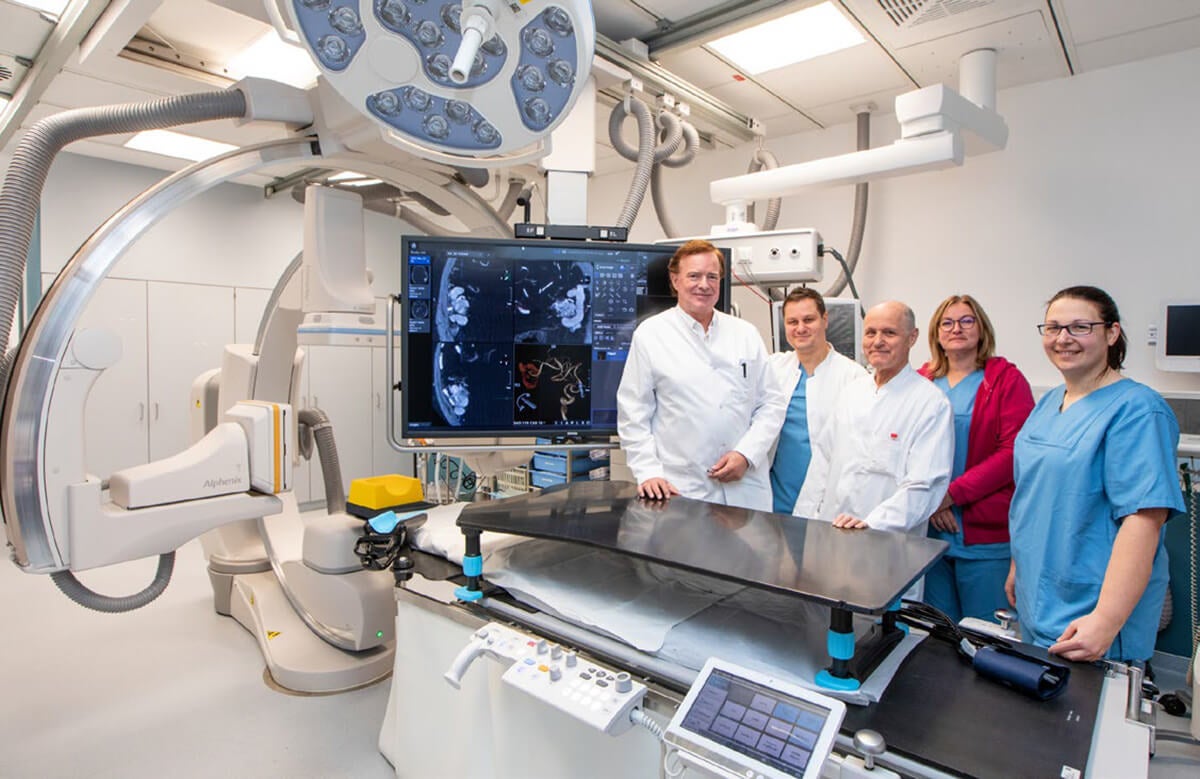 Professor Lanfermann (left) and his team are delighted about the new angiography equipment. Copyright: Karin Kaiser / MHH.
Stroke, cerebral hemorrhage, aneurysm, vasoconstriction: for these vascular diseases, angiography not only enables precise diagnosis but also allows for minimally invasive, often life-saving treatments to be performed simultaneously.
Since the summer of 2023, a new, extremely powerful angiography system (Alphenix Biplane) from Canon has been installed at the Institute of Diagnostic and Interventional Neuroradiology at Hannover Medical School (MHH). The Alphenix Biplane has a very high-resolution image detector, which enables optical magnification of the brain vessels by a factor of two and reduces radiation exposure. This means that patients can be offered even better treatment, for example, in the event of a severe stroke.
Thrombectomy Removes Blood Clots
Every year, the Interventional Neuroradiology department treats around 700 people with various vascular diseases of the brain, spine, or spinal cord, as well as tumors of the head and neck. Around 220 of these are patients who have suffered a stroke.
The aim is to remove the blood clot in the cerebral vessel responsible for the stroke as quickly as possible in order to restore the blood supply to the brain. If this cannot be achieved with medication, a thrombectomy can be performed using angiography imaging. "This involves inserting a telescopic catheter system from the groin or forearm into the affected cerebral vessel and either aspirating the clot or pulling it out," explains Dr. Friedrich Götz, Head of Interventional Neuroradiology.
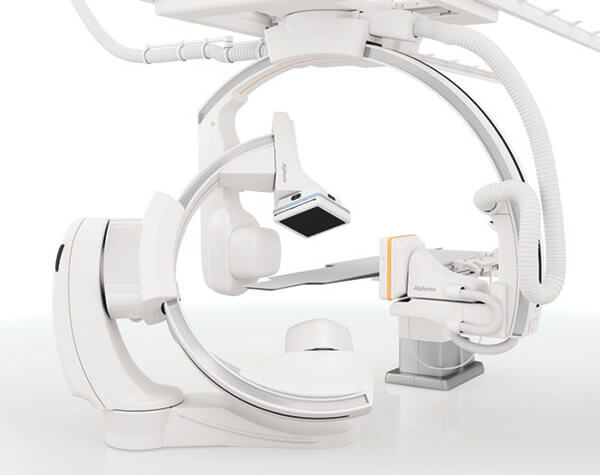 Alphenix Biplane.
Proven Treatment Becomes Even More Effective
“The possibility of applying thrombectomy of brain supplying vessels soonest after stroke onset has significantly improved the stroke treatment success rate in recent years," says Prof. Heinrich Lanfermann, Director of the Institute of Diagnostic and Interventional Neuroradiology. Until now, the procedure has mainly been used when large blood vessels in the brain are blocked by a clot. The new angiography system installed in the department, Alphenix Biplane, now provides excellent additional options in this area.
Thanks to the high magnifications and excellent image quality, even smaller vessels that supply the speech center in the brain can now be shown very well, so that thrombectomies can also be carried out there under the best possible control. "This is a great benefit for the patients concerned," emphasizes Prof. Lanfermann.
New Possibilities, Less X-Ray Radiation
Another technical innovation of the system is the so-called Alpha CT Stent feature. It creates high-contrast CT-like slices of very small vessels and implanted stents. This is advantageous, for example, for the treatment of aneurysms (i.e., vascular protrusions): "The images allow us to see exactly whether the vessel wall apposition of the stent inserted for stabilization is sufficient or whether we still need to optimize its position.” explains senior physician Dr. Omar Abu-Fares.
The neuroradiologist is also enthusiastic about another innovation, Alphenix Spot ROI: "With this innovation, the system works with less X-ray radiation. Only the selected target area is exposed to the necessary dose of radiation, while the surrounding tissue receives significantly less dose."
More Flexibility in Emergencies
The new angiography system fits perfectly into the existing technical equipment at the institute. It is located close to the CT and the extended and newly equipped anesthesia induction rooms. This means that patients do not have to be moved far during Alphenix Biplane. treatment. "The best thing, however, is that we now have not just one, but two angiography units with identical technical equipment," explains Dr. Götz. "With these two devices, we are now extremely flexible. We can carry out planned interventions and also treat emergencies at the same time."
Close Collaboration with Other Specialty Areas
Diagnostic and interventional neuroradiology does not work on its own but in close cooperation with other specialties such as neurology, neurosurgery, anesthesia, angiology, vascular surgery, and ear, nose, and throat medicine. For example, neuroradiology is a permanent partner of the supra-regional certified stroke unit (i.e. the stroke unit of the Clinic for Neurology). It offers all diagnostic and therapeutic procedures for stroke patients around the clock, 365 days a year - including thrombectomy. Professor Lanfermann is certain that "Especially in stroke treatment, the new angiography system will bring us another big step forward." //
This article is a reprint from the international VISIONS magazine #43, published by Canon Medical Systems Europe B.V.
The content reflects information available at the time of publication and may differ from current information.
Social Media


